Showing posts with label Henry Heth. Show all posts

Saturday, January 18, 2014

When War Wasn't Civil

The Shelton Laurel Massacre an execution of 13 men and boys accused of being Union sympathizers occurred on January 18th 1863 in Madison County, North Carolina.

In early January 1863 an armed group of Madison County, North Carolina Unionists looted the salt stores in the area and ransacked the home of Confederate Colonel Lawrence Allen.  Allen was the commander of the 64th North Carolina Infantry.  In response to the raid Confederate General Henry Heth sent the 64th; temporarily commanded by Lieutenant Colonel James A Keith, to Shelton Laurel Valley to catch the looters.   In the following skirmish 12 of the looters were killed and a number others captured.  North Carolina Governor Zebulon Baird Vance worried about the situation escalating sent orders not to harm the captured looters.

Keith however believed a rumor that there was a Unionist force in the area, and he began looking for them.  Locals weren’t forthcoming with information and so Keith had several women in the Shelton Laurel area rounded and tortured to get information about their male relations.  After rounding up the alleged Unionists, Keith started to march them to Tennessee, but two of the captives escaped.  At this point Keith had the remaining 13 prisoners marched into the woods where on January 18th 1863 he ordered them shot.  The bodies of the thirteen men; three of them boys under the age of 17 were dumped into a trench.


Family of executed men had their bodies move to a cemetery a little east of the massacre site.  Keith was held for his actions spending two years in jail, before escaping just days before his trial.  The state dropped their case against him.

Sunday, August 25, 2013

We Can Beat Them Yet

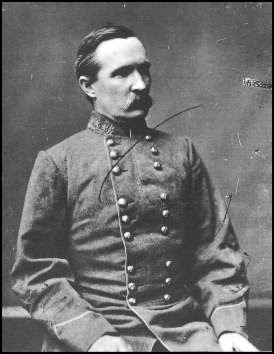
Confederate General Henry Heth
The Second Battle of Ream’s Station was fought August 25th 1864 in Dinwiddie County, Virginia, a part of the Petersburg Campaign.

As the siege of Petersburg began to take hold, Union Lieutenant General Ulysses S Grant began to look for ways to break the railroad lines, and prevent supplies from reaching Confederate General Robert E Lee’s Confederates.  Grant wanted the Petersburg and Weldon Railroad, which ran into Wilmington, North Carolina, stopped and had sent Major General Winfield Scott Hancock’s II Corps in June and Major General Gouverneur K Warren’s V Corps against the railroad in early August.

On August 22nd 1864 Grant again sent out the II Corps along with a cavalry division under Brigadier General David M Gregg.  Gregg’s men drove off some Confederate pickets, and one of the II Corps division commanders, Brigadier General Nelson A Miles’ men destroyed the track to within 2 miles of Reams Station.  Early the next morning August 23rd 1864 another II Corps commanded Brigadier General John Gibbon took up position in some old earthworks located at Reams Station.  Lee couldn’t afford to lose the railroad supply line, and also Ream’s Station was the county seat and should they need it, a potential retreat route.  He sent in Confederate Lieutenant General A P Hill’s Corps which was being led at the time by General Henry Heth, along with two divisions of Major General Wade Hampton’s cavalry to drive them out.

On August 25th 1864 Union troops left their earthworks to destroy the last 5 miles of tracks.  Hancock had them recalled when Confederate cavalry approached.   Hill’s column had advanced down the Dinwiddie Stage Road, and at about 2 pm three infantry brigades led by Brigadier General Cadmus Wilcox launched an attack, but were driven back.  At about the same time some of Hampton’s cavalry had swept around the Union line, but were blocked by Gibbon’s division.  More of Hill’s Corps were brought up, and Confederate Colonel William Pregram’s artillery began firing on the Union position.  The final attack began around 5:30 pm, with the Confederates breaking through the northwest part of the Union fortifications.  Two Union regiments panicked and ran and the Confederates charged the earthworks.  Hancock galloped along the front of his men trying to rally his men; he said “We can beat them yet. Don't leave me, for God's sake!"  The Confederate cavalry at this point made a dismounted charge against Gibbon’s troops causing them to panic, and giving Hampton room to flank the Union line.  Hancock pulled together a counterattack that allowed the Union side to make a withdrawal back to Petersburg.

Union casualties were high, numbering about 2,750 along with 9 cannon and 12 stands of colors, while the Confederates lost only about 800.

Monday, January 21, 2013

Always A Colonel

Confederate Colonel John Mercer Brockenbrough resigned his commission on January 21st 1864.

John Mercer Brockenbrough was born August 1st 1830 in Richmond County, Virginia, the son of Moore Fauntleroy and Sarah Waller (Smith) Brockenbrough.  He attended and graduated from the Virginia Military Institute in 1850.

Brockenbrough was appointed the Colonel of the 40th Virginia at the start of the Civil War.  They were a part of Confederate Major General A P Hill’s Light Division.  Brockenbrough led his men during the Seven Days Battles seeing casualties of about 50%.  At the Battle of Chantilly he moved up to Brigade command, and continued there through the battles of Harpers Ferry, Sharpsburg, and Fredericksburg.  In the early part of the 1863 Confederate Brigadier General Henry Heth replaced Brockenbrough as the brigade commander.  But, when A P Hill was wounded at the Battle of Chancellorsville, Heth moved up and Brockenbrough got his brigade back.  His men saw action at Gettysburg on the afternoon of July 1st 1863, fighting against Union Colonel Roy Stone’s Pennsylvania Buck Tails, and as part of Pickett’s Charge on the 3rd.

Following a reckless charge on Union troops at the Battle of Falling Waters on July 14th 1863; a part of the Confederate retreat from Gettysburg, Brockenbrough was removed from Brigade command and he resumed command of the 40th Virginia.  He led the 40th the Battles of Bristoe and Mine Run, before resigning his command January 21st 1864 still as a Colonel.

Brockenbrough lived in Norfolk and Richmond, Virginia following the war.  He died August 25th 1892 in Richmond, Virginia and is buried in the Hollywood Cemetery there.

Monday, October 24, 2011

The Little Gamecock


Confederate General James Jay Archer died October 24th 1864 from an illness he developed while a Prisoner of War.

James Jay Archer was born December 19th 1817 near Havre de Grace, Maryland the son of John and Ann [Stump] Archer.  He attended Princeton University; where he picked up the nickname “Sally” do to his small stature.  Archer graduated in 1835 and attending Bacon College in Georgetown, Kentucky he went on to study law at the University of Maryland.  He had a successful law practice going when the Mexican American War broke out.  Archer volunteered for service and was cited for bravery at Chapultepec, receiving a brevet to Major.  He moved to Texas following the war in 1848 were he was wounded in a duel.  Archer returned to law in Maryland, but decided in 1855 to join the United States Army as a Captain in 9th US Infantry.  He served mostly in the Pacific Northwest.

When the Civil War started Archer was at Fort Walla Walla in Washington Territory.  He resigned March 14th 1861, and shortly after was a member of the Confederate Army.  Archer was made a Colonel in the 5th Texas Infantry, and served with excellence at the Battle of Eltham’s Landing and Seven Pines.  On June 3rd 1862 he was promoted to Brigadier General and given command of three Tennessee regiments.  They fought as part of Major General A P Hill’s “Light Division” at Cedar Mountain and Second Bull Run, where he had a horse shot from under him.  His men called him “The Little Gamecock”.  Archer was to sick to ride a horse during the Maryland Campaign of September 1862, and led them from an ambulance.  His men contributed to the victories at the Battles of Fredericksburg and Chancellorsville.  By the summer of 1863 Archer’s brigade was part of Major General Henry Heth’s Division, A P Hill’s Corps.
On July 1st 1863 Archer was taken prisoner at the Battle of Gettysburg.  Union Private Patrick Maloney of the 2nd Wisconsin captured him, making Archer the first general to be captured in the Confederate army since General Robert E Lee took command.  Archer was sent to Johnson’s Island on Lake Erie where the Ohio winter cause his health to decline.  After a year at the Fort Johnson prisoner of war camp, Archer was sent with 600 other Confederate officers to Charleston Harbor.  He was exchanged late in the summer of 1864.  He rejoined the Confederate army on August 9th 1864 as part of the Army of Tennessee, but due to his poor health was order to Petersburg, Virginia.  He collapsed following the Battle of Peebles’ Farm.  Archer died October 24th 1864 in Richmond, Virginia and is buried Hollywood Cemetery.

Thursday, August 25, 2011

Kirby's Army

The Confederate Army of Kentucky was designated such August 25th 1862 and led by Edmund Kirby Smith.


The Army of Kentucky was designated and placed under the command of Kirby Smith August 25th 1862. This army was made of troops from the Confederate Department of Eastern Tennessee. It was made up of infantry divisions of Thomas J Churchill, Patrick Cleburne, Henry Heth and Carter L Stevenson. It also included the Confederate cavalry brigades of John Hunt Morgan and John S Scott.

Following the Battle of Perryville Kirby Smith received a promotion and was given the command of the Department of Trans Mississippi.

Friday, July 1, 2011

It All Started With One Shot

Union Lieutenant Marcellus E Jones fired the first shot July 1st 1863, that started the three day Battle of Gettysburg.


Union Cavalry under the command of Brigadier General John Buford were waiting on July 1st 1863, for a Confederate force coming from the northwest. Buford could see that the high ground around Gettysburg was important to hold. He planned to hold the hills west of Gettysburg, as a delaying action until the Union First Corps under General John Reynolds could bring up more men.

Confederate Major General Henry Heth’s Division led the way into Gettysburg with Major William J Pegram artillery. This was followed by two brigade of infantry under the command of Brigadier Generals James Jay Archer and Joseph Robert Davis. They were moving along the Chambersburg Pike, about three miles west of town at 7:30am when they met a cavalry vedette. The Union cavalry that Heth’s division ran into were dismounted troops from Colonel William Gamble’s brigade. Lieutenant Marcellus E Jones of the 8th Illinois Cavalry fired the opening shot of the Battle of Gettysburg, firing at a man on a gray horse about a half mile away.

Buford’s small force of 2,748 cavalry would soon face and hold off 7,600 Confederates.

This is a very good web site for information about the first shot and the man who made that shot, Battle of Gettysburg: Who Really Fired the First Shot

Wednesday, January 12, 2011

A Confederate Family Twig

Confederate General Joseph Robert Davis, the nephew of Confederate President Jefferson Davis was born January 12th 1825.

Joseph Robert Davis was born in Woodville, Wilkinson, Mississippi, January 12th 1825 the son of Isaac William and Susannah [Gartley] Davis. Isaac was the older brother of Confederate President Jefferson Davis. Joseph was educated in Kentucky and then went on to graduate from Miami University in Ohio. He returned to Madison County, Mississippi were he married and opened a law practice.

When the Civil War started Davis entered the Confederate army as a Captain in the 10th Mississippi Infantry. He served in the Pensacola, Florida area before becoming the aide-de-camp for President Jefferson Davis. Davis received a promotion to Brigadier General on September 15th 1862. There were critics who felt his promotion was a case of nepotism. Davis had command of a brigade which patrolled the Richmond and southeastern Virginia area. In the Spring of 1863 Davis was assigned to Henry Heth’s Division of the Army of Northern Virginia. He was in command of the 42nd, 11th, 2nd Mississippi and 55th North Carolina. Davis’ Brigade saw action early on July 1st 1863 on the first days Battle of Gettysburg. Davis saw many of his men killed or captured in the railroad cut on McPherson‘s Ridge. What was left of his brigade took part in the Pickett - Pettigrew - Tremble Charge on July 3rd 1863. Davis served through out the war seeing action at the many battles that the Army of Northern Virginia participated in, and was present at their surrender at Appomattox Courthouse.

After the war Davis returned to Mississippi where he continued with his law practice, and was a Mississippi State Senator. He died in Biloxi, Mississippi and is buried in the Biloxi Cemetery.

Wednesday, August 18, 2010

Second Try To Cut The Rail Line

The Battle of Globe Tavern [also called Second Battle of Weldon Railroad] was begun on August 18th 1864. South of Petersburg Virginia this was the Union Armies second shot at severing the Weldon Railroad during of Siege of Petersburg. At dawn on August 18th 1864 Major General Gouverneur K Warren advanced from the Petersburg entrenchments, driving the confederates ahead of them, they reached the railroad at Globe Tavern. He sent in a division under Brigadier General Charles Griffin to destroy track, while another division under Brigadier General Romeyn B Ayres formed a battle line to block the Confederate advance. In the afternoon Confederate Major General Henry Heth attacked, pushing the Union division back toward the tavern. Both sides trenched in for the night.


After four days of fighting, the Union Army had extended its siege line, cutting off the primary rail line between Petersburg and Wilmington NC. This caused the Confederates to have to have to haul supplies 30 miles by wagon from the Stony Creek Station.

Tuesday, June 30, 2009

Looking For Shoes

Brigadier General James J Pettigrew marched into Gettysburg PA on June 30th 1863 in search of shoes.

James J Pettigrew who was in command of a brigade in General Henry Heth’s division was ordered to march to Gettysburg PA to investigate a report of supplies located in the town. As he approached to town using the Chambersburg Pike; from Seminary Ridge about 10am, Pettigrew saw Union Cavalry on McPherson’s Ridge. As Robert E Lee had given orders not to engage the enemy, he retreated and reported to the sighting to Heth and General AP Hill.

Heth didn’t believe the men Pettigrew had seen were Union Regulars, but only Pennsylvania Militia. The next day AP Hill sent Henry Heth’s division with the support of Dorsey Pender’s into Gettysburg, where they were met by Buford’s Union Cavalry and John Reynolds’ corp. Heth would be wounded during the battle and command of the division would pass the Pettigrew.

Friday, December 19, 2008

The First General Prisoner


James Jay Archer the first general captured from the Army of Northern Virginia was born on December 19th 1817.

James Jay Archer was the son of John and Ann [Stump] Archer and was born December 19th 1917 in Bel Air, MD. In 1835 he graduated from Princeton, and than studied law at the University of Maryland. When the Mexican-American War began he volunteered for service in the United States Army. He was cited for bravery brevetted to the rank of Major. After the war he return to his law practice, but decided in 1855 to re-join the army as a Captain in the 9th United States Infantry.

At the beginning of the Civil War Archer was stationed at Fort Walla Walla, Washington. He resigned his commission on May 14th 1861 and joined the Confederate Army. Although he was a native of Maryland, he became the Colonel of the 5th Texas Infantry. Archer was promoted on June 3rd 1862 to Brigadier General and given command of regiments from Tennessee. These units would be joined by others to form the “Light Division” under General AP Hill.

At Gettysburg Archer’s health was deteriorating. His brigade was now part of Major General Henry Heth’s division. On the first day of fighting, after attacking Union Major General John F Reynolds first Corps, and than being pushed back across Willoughby Run, the sick and exhausted Archer took cover in a thicket, where Union Private Patrick Maloney of the 2nd Wisconsin took Archer prisoner. This made him the first General to be captured from the Army of Northern Virginia since Robert E Lee took over command. He was sent to Fort Delaware along with his younger brother and aide-de-camp Robert Harris Archer. James Archer was eventually sent to Johnson’s Island in Ohio on the coast of Lake Erie, where he was held for about a year. He was exchanged in the late summer of 1864, reporting on August 9th to the Army of Tennessee. It was during the Siege of Petersburg that his health caused a collapse after the Battle of Peebles’ Farm. He died October 24th 1864 in Richmond, VA and is buried in Hollywood Cemetery.