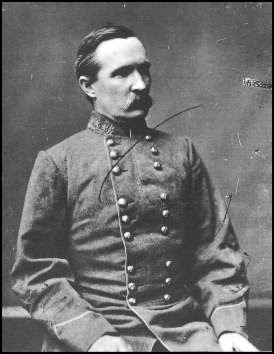
Showing posts with label Gouverneur K Warren. Show all posts

Friday, May 23, 2014

At A Crossing

The Battle of Jericho Mills a part of Grants Overland Campaign was fought May 23rd 1864 between the Union V Corps and a part of AP Hill’s Corps.
After the fighting at Spotsylvania Court House came to end Union General Ulysses S Grant moved to flank Confederate General Robert E Lee’s Army of Northern Virginia.  He was brought up short by Lee’s “Hog Snout Line” along the North Anna River.  At that point Grant divided the Army of the Potomac into three parts.

Union General Gouverneur K Warren reached Mount Carmel Church on the morning of May 23rd 1864.  He stopped his V Corps which caused Union General Winfield S Hancock’s II Corps to come up behind and get tangled on the road.  The two commanders decided that the II Corps would move down Telegraph Road while the V Corps would cross the North Anna at Jericho Mills.

As they moved down the Telegraph Road, Union Major David B Birney’s division of the II Corps began to take fire.  He deployed two brigades and attacked.  They also called up artillery which opened fire on Confederate Colonel Edward P Alexander’s artillery.  It was during this duel that Lee was just missed by a cannonball which lodged in the door frame near him, and Alexander was hit by bricks from the chimney which was hit by Union shells.  At 6pm the Union troops charged, overwhelming the Confederate at the bridge.  With Alexander’s artillery still lying down a heavy fire, the Union troops did not cross the bridge, but entrenched on the north side of the river.

Meanwhile at Jericho Mills, the V Corps found the North Anna ford unprotected.  Warren sent Union Brigadier General Charles Griffin’s Division across the river while the rest the Corps crossed by 4:30 pm on a pontoon bridge.  Finding out from a captured Confederate that there was a force nearby on the Virginia Central Railroad, Warren deployed for battle.  Lee felt that Warren’s movement was a feint and so had AP Hill send a single division under Major General Cadmus M Wilcox, with artillery commanded by Colonel William J Pegram.  The Confederates struck Warren’s Corps hard, breaking their line and causing them to flee to the rear where they came up against the bluffs along the river.  Warren’s Corps was saved in part by Union Colonel Charles S Wainwright’s artillery which laid down a deadly fire on the Confederates.  It was also at about this time that Union Brigadier General Joseph J Bartlett led his 83rd Pennsylvania Infantry against the right flank of the Confederate line causing them to retreat and leaving that part of the line untenable.  Seeing that reinforcements from Confederate Major General Henry Heth would not reach the field in time, Wilcox had his men withdraw.


Wilcox was greatly outnumbered with about 6,000 men to the Union’s 15,000.  There were about 730 Confederate casualties, while the Union reported 377.

Sunday, August 25, 2013

We Can Beat Them Yet

Confederate General Henry Heth
The Second Battle of Ream’s Station was fought August 25th 1864 in Dinwiddie County, Virginia, a part of the Petersburg Campaign.

As the siege of Petersburg began to take hold, Union Lieutenant General Ulysses S Grant began to look for ways to break the railroad lines, and prevent supplies from reaching Confederate General Robert E Lee’s Confederates.  Grant wanted the Petersburg and Weldon Railroad, which ran into Wilmington, North Carolina, stopped and had sent Major General Winfield Scott Hancock’s II Corps in June and Major General Gouverneur K Warren’s V Corps against the railroad in early August.

On August 22nd 1864 Grant again sent out the II Corps along with a cavalry division under Brigadier General David M Gregg.  Gregg’s men drove off some Confederate pickets, and one of the II Corps division commanders, Brigadier General Nelson A Miles’ men destroyed the track to within 2 miles of Reams Station.  Early the next morning August 23rd 1864 another II Corps commanded Brigadier General John Gibbon took up position in some old earthworks located at Reams Station.  Lee couldn’t afford to lose the railroad supply line, and also Ream’s Station was the county seat and should they need it, a potential retreat route.  He sent in Confederate Lieutenant General A P Hill’s Corps which was being led at the time by General Henry Heth, along with two divisions of Major General Wade Hampton’s cavalry to drive them out.

On August 25th 1864 Union troops left their earthworks to destroy the last 5 miles of tracks.  Hancock had them recalled when Confederate cavalry approached.   Hill’s column had advanced down the Dinwiddie Stage Road, and at about 2 pm three infantry brigades led by Brigadier General Cadmus Wilcox launched an attack, but were driven back.  At about the same time some of Hampton’s cavalry had swept around the Union line, but were blocked by Gibbon’s division.  More of Hill’s Corps were brought up, and Confederate Colonel William Pregram’s artillery began firing on the Union position.  The final attack began around 5:30 pm, with the Confederates breaking through the northwest part of the Union fortifications.  Two Union regiments panicked and ran and the Confederates charged the earthworks.  Hancock galloped along the front of his men trying to rally his men; he said “We can beat them yet. Don't leave me, for God's sake!"  The Confederate cavalry at this point made a dismounted charge against Gibbon’s troops causing them to panic, and giving Hampton room to flank the Union line.  Hancock pulled together a counterattack that allowed the Union side to make a withdrawal back to Petersburg.

Union casualties were high, numbering about 2,750 along with 9 cannon and 12 stands of colors, while the Confederates lost only about 800.

Friday, March 29, 2013

Step Towards Appomattox

The first move of the spring of 1865 was the Battle of Lewis’s Farm was fought March 29th 1865 in Dinwiddie County, Virginia and was the opening of the Appomattox Campaign.

Union Lieutenant General Ulysses S Grant opened his spring campaign on March 29th 1865 by sending Major General Philip Sheridan’s cavalry followed by the Union V Corps to turn the right flank of Confederate General Robert E Lee’s Petersburg defenses.  Union Major General Gouverneur K Warren, who commanded the V Corps, moved his troops up the Quaker Road, at the intersection of the Boydton Plank Road, they ran into Confederate Major General Bushrod Johnson’s brigade.

Union Brigadier General Joshua L Chamberlain led the main advance.  The Confederates were pushed back into entrenchments on the White Oak Road.  Confederate Lieutenant General Richard H Anderson ordered two brigades forward in an attempt the intercept the Union troops.  Chamberlain, who was wounded, rallied his men around an artillery battery, counterattacked and took the Confederate entrenchments.  There were reported casualties of 370 Confederate and 380 Union.

The Battle of Lewis’s Farm is also sometimes called Gravelly Road, Military Road of Quaker Road.

Wednesday, August 22, 2012

He Received The Masonic Sign

A member of the 140th Pennsylvania Infantry, Henry Harrison Bingham received his commission on August 22nd 1862 to First Lieutenant.

Henry Harrison Bingham was born December 4th 1841 in Philadelphia, Pennsylvania.  He attended Jefferson College in Canonsburg, Pennsylvania, and would graduate with a law degree from Washington and Jefferson College in Washington, Pennsylvania.

Bingham enlisted in the Union Army, and was commissioned First Lieutenant in the 140th Pennsylvania Infantry August 22nd 1862.  During the Battle of Gettysburg he was part of Union Major General Winfield Scott Hancock’s Second Corps.  He was near the Angle as Pickett’s Charge came to its conclusion.  Bingham would be the man to whom Confederate Brigadier General Lewis Addison Armistead gave the Masonic sign after being wounded. [Although this story has been discounted recently.] Bingham who was a Captain would come to Armistead’s aid, receive his personal effects and tell Hancock the news of his old friend.  During the Battle of Wilderness Bingham was the aide-de-camp to Union Major General Gouverneur Kemble Warren.  As a Captain in Company G of the 140th Pennsylvania on May 6th 1864 he "rallied and led into action a portion of the troops who had given way under fierce assaults of the enemy."  For this action he would be awarded the Medal of Honor.  Bingham was wounded at the Battle of Spotsylvania and captured at the Battle of Fair Oak.

After the war Bingham was appointed by President Andrew Johnson to Postmaster of Philadelphia, a post he held until December 1872.  He was a delegate at the Republican National Conventions from 1872 through 1900.  He was a Congressman from 1879 until his death, serving as the Chairman of several committees.  Bingham died March 22nd 1912 in Pennsylvania and is buried in the Laurel Hill Cemetery in Philadelphia.

Thursday, March 31, 2011

The Road To The End

The day before the Confederate loss at the Battle of Five Forks, on March 31st 1865 the Battle of White Oak road was fought.

Confederate General Robert E Lee moved his reinforcements March 30th 1865 to cover a Union movement on his right flank. Confederate Major WHF Rooney Lee’s cavalry moved to Five Forks, and Major General George Pickett’s division to Bermuda Hundred. The V Corps under Union Major General Gouverneur K Warren entrenched along the Boydton Plank Road, and Major General Romeyn B Ayres moved toward White Oak Road. On March 31st 1865 Warren moved his Corps on the Confederates entrenched along the White Oak Road. The plan being to cut Confederate communications with Pickett. A counterattack by Confederate Major General Bushrod Johnson slowed up the Union advance, however Warren’s men pulled it together and by the end of the day, the Union held the road.

Confederate loss were about 750, Union about 1,900.

Saturday, February 5, 2011

Turn The Right Flank

The Battle of Hatcher’s Run, part of the Siege of Petersburg was fought February 5th 1865.

Union Brigadier General David M Gregg’s Cavalry traveled west to Dinwiddie Court House on the Malone Road on February 5th 1865, looking to intercept Confederate supplies. The V Corps under command of Major General Gouverneur K Warren took a position to protect Gregg’s right flank on the Vaughen Road. Two divisions of the Second Corps under command of Major General Andrew A Humphreys moved from Hatcher’s Run to Armstrong’s Mill to cover Warren’s right flank. In the late afternoon Confederate Major General John B Gordon attacked Humphrey’s men near the Mill planning to turn their right flank. The Union troops held their line and repulsed Gordon’s men. During the night the Union Second Corps was reinforced by two divisions, extending the line south of Hatcher’s Run.

The movements here continued for two more days, with the line moving back and forth. On February 6th 1865 Confederate Brigadier General John Pegram was killed taking Hatcher’s Run. The next day February 7th 1865 Union forces recaptured the lines lost the day before. The two sides saw about 2,700 casualties in the three days of fighting.

Wednesday, August 18, 2010

Second Try To Cut The Rail Line

The Battle of Globe Tavern [also called Second Battle of Weldon Railroad] was begun on August 18th 1864. South of Petersburg Virginia this was the Union Armies second shot at severing the Weldon Railroad during of Siege of Petersburg. At dawn on August 18th 1864 Major General Gouverneur K Warren advanced from the Petersburg entrenchments, driving the confederates ahead of them, they reached the railroad at Globe Tavern. He sent in a division under Brigadier General Charles Griffin to destroy track, while another division under Brigadier General Romeyn B Ayres formed a battle line to block the Confederate advance. In the afternoon Confederate Major General Henry Heth attacked, pushing the Union division back toward the tavern. Both sides trenched in for the night.


After four days of fighting, the Union Army had extended its siege line, cutting off the primary rail line between Petersburg and Wilmington NC. This caused the Confederates to have to have to haul supplies 30 miles by wagon from the Stony Creek Station.

Wednesday, April 1, 2009

Five Forks

General George Pickett was told to “Hold Five Fork at all hazards”, but on April 1st 1865 the Union had other ideas.

General Philip H Sheridan had moved his Federal troops forward on March 31st 1865, but the Confederates had managed to halt his progress. Sheridan’s focus was a road intersection known as Five Forks that was a pivotal point on Robert E Lee’s supply line. Lee ordered General Pickett to hold that cross road at all cost.

On April 1st Sheridan’s men supported by General Gouverneur K Warren’s 5th Corps attacked the Confederate’s with about 20,000, crushing Pickett’s 10,000. While the Union lost only about 1,000 men, there were 5,000 Confederates killed, wounded, or captured. During the battle a long standing disagreement between Sheridan and Warren came to a head and Sheridan had Warren removed from his command with General Ulysses S Grant’s approval. [Warren was cleared of any wrong doing in 1882.] With the vital intersection in Union hands and Lee’s supply lines were cut forcing the Rebel’s to evacuate Petersburg ending the ten month long siege.

More reading
Five Forks: Waterloo of the Confederacy

Battle of Five Forks