Showing posts with label Fort Sumter. Show all posts

Monday, April 7, 2014

Like The Fires Of Hell

On April 7th 1863 nine Union ironclads neared Fort Sumter to attack the Confederate held structure.

Nine Union ironclads, outfitted with the heaviest cannon to be used in naval warfare up to that time, steamed slowly into Charleston Harbor on April 7th 1863.  They were moving in for an attack on Fort Sumter.  At about 3 pm the Fort under the command of Confederate Colonel Alfred Rhett opened up on the Union ships, in what one Union man said was like "the fires of hell were turned upon the Union fleet. The air seemed full of heavy shot, and as they flew they could be seen as plainly as a base-ball in one of our games."

The Confederate batteries in the Forts of Charleston Harbor fired off more than 2,200 rounds during the battle, while the Union ironclads only fired 139 shots.  The Union guns hit Fort Sumter 55 times during the fight, leaving the Fort pretty much intact.  The ironclads didn’t make out as well during the roughly hour long battle, one of the ships, the USS Keokuk received over 90 hits, and it was only with dedication and skill that her sailors and commander Alexander C Rhind, kept her afloat until the next morning.  Among the remaining ironclad there were disabled guns, and damaged smokestacks and turrets.  Union Rear Admiral Samuel Francis DuPont who led the fleet, withdrew ships and did not renew the fight.


The Union side reported 23 casualties, while the Confederates in the Forts had 14.  The Confederates were even able to salvage one of the Dahlgren guns from the wreck of the Keokuk, which would be mounted on the Fort. 

Monday, January 28, 2013

To Replace The National Flag

The flag adopted by the Confederate State of South Carolina on January 28th 1861 had a white palmetto tree on a blue background.

South Carolina has had a flag since 1765 when the opponents of the British Stamp Acts carried one in protest with three white crescents on a blue background.  In 1861 the people of the state added the palmetto tree, symbolizing the use of the tree by Moultrie during the Revolution, which with sand laid over withstood British cannons.

It was decided after many designs that the Republic of South Carolina would replace the national flag.  It would have a blue background with an upward facing crescent.  The South Carolina General Assembly added a golden palmetto tree encircled by a white background.  This flag became known as the two day flag as the gold palmetto was changed two days latter to a plain white tree on January 28th 1861.  It was this flag which was raised over Fort Sumter April 14th 1861 when the fort surrendered to Confederate General PTG Beauregard.

Tuesday, January 1, 2013

The First Volunteers

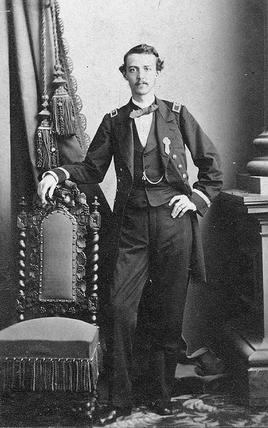
Maxcy Gregg
The 1st South Carolina Infantry known as “Gregg’s First” was constituted January 1st 1861 by an order of South Carolina Governor Francis W Pickens.

South Carolina Governor Francis W Pickens passed an order for the formation of a regiment of soldiers for the state on January 1st 1861.  The 1st South Carolina Volunteers was raised for six months and mustered in at Columbia, South Carolina February 1st 1861 under the command of Colonel Maxcy Gregg.  The regiment was made up of 11 companies, one more then called for, so Company “D” became artillery.  They moved to join other military units on Morris and Sullivan Islands and served as part of the forces bombing Fort Sumter.  In April the 1st was sent to Richmond, Virginia, the first regiment from another state to transfer to the Army of Northern Virginia.  Their enlistment ended in early July 1861.

Saturday, November 10, 2012

The First To Leave The Senate

James Chestnut Jr a United States Senator, and Confederate General was the first Southern Senator to resign from the United States Senate on November 10th 1860.

James Chesnut Jr was born January 18th 1815 at the family home Mulberry Plantation in Camden, South Carolina, the son of James and Mary (Cox) Chesnut.  He was the youngest of fourteen children and the only surviving son.  The family was among the wealthiest of southern planters.  Chesnut graduated from the College of New Jersey in 1835 and opened a practice in Camden in 1837.  He married Mary Boykin Miller April 23rd 1840 [she is well known for the diary she kept during the War].  He quickly became a rising star in southern politics, becoming a member of the South Carolina House of Representatives in 1840, the South Carolina State Senate in 1852 and serving as its president 1856-58.
In 1858 the South Carolina Legislature voted to send Chesnut to Washington to replace United States Senator Josiah J Evans.  Although he defended states’ rights and slavery, Chesnut opposed restarting the slave trade and was not strongly in favor of secession.  Following the election of Abraham Lincoln, Chesnut felt he could no longer serve in his office as Senator.  He became the first of the Southern senators to resign their seats on November 10th 1860.

Chesnut was at the South Carolina secession convention in December 1860 and would be elected to the Provisional Congress of the Confederate States of America, a part of the committee who drafted the Confederate Constitution.  Chesnut gave the orders to open fire on Fort Sumter on April 12th 1861; he was serving as the aide-de-camp to Confederate P G T Beauregard.  In 1864 he was promoted to Brigadier General and commanded a South Carolina reserve unit until the end of the war.
Following the Civil War Chesnut returned to practicing law in Camden, South Carolina.  He died at his home in Camden, South Carolina February 1st 1885 and is buried in the Knights Hill Cemetery there.

Sunday, October 28, 2012

A Commemorative Medal

The Union Gillmore Medal given to men who fought in the Charleston, South Carolina area was first issued on October 28th 1863.

The Gillmore Medal was named after Union Major General Quincy Adams Gillmore, who commanded the troops that attempted to re-take Fort Sumter in 1863.  The medal is sometimes also called the Fort Sumter Medal it commemorates the Union troops who fought in the Charleston, South Carolina area in 1863.  The Medal was presented to all the men who served under Gillmore’s command, and was first awarded on October 28th 1863 by an order stating, “medals of honor for gallantry and meritorious conduct during the operations before Charleston".

The Gillmore Medal was suspended from a swivel without a ribbon, it attached to the uniform with a metal clasp.  The Medal was designed by the Ball, Black, and Company of New York City.  The Gillmore Medal was declared obsolete in 1905 when the Civil War Campaign Medal was created.

Monday, October 1, 2012

I Grieve The Loss

Confederate Brigadier General John Dunovant was killed October 1st 1864 at the Battle of Vaughan Road, a part of the Siege of Petersburg.

John Dunovant was born 1825 in Chester, South Carolina the son of John and Margaret (Sloan Quay) Dunovant.  During the Mexican American War he was a Sergeant in a volunteer regiment and was wounded at the Battle of Chapultepec.  He joined the United State Army as a Captain in the 10th Infantry March 1855.

Dunovant resigned on December 29th 1860 and offered his service to the South Carolina militia.   He was present at Fort Moultrie during the bombardment of Fort Sumter.  He was stationed there when he became the Colonel of the 1st South Carolina Infantry July 1861.  Dunovant was cashiered November 1862 for being drunk, but was back commanding July 28th 1863 this time with the 5th South Carolina Cavalry.  In May 1864 the 5th with Dunovant was placed in Confederate Major General Wade Hampton’s Division a part of Jeb Stuart’s Cavalry.  They saw action at numerous engagements including the Second Battle of Drewry’s Bluff, the Battle of Cold Harbor and many of the encounters against Union General Philip Sheridan in the Shenandoah Valley.  Dunovant was wounded at the Battle of Haw’s Shop May 28th 1864.  He was appointed to Brigadier General August 22nd 1864 and given command of a brigade.

On October 1st 1864; while fighting north of the James River, in a part of the Battle of Peebles’ Farm known as the Battle of Vaughan Road, Dunovant was shot and killed while leading his men in a charge.  After he fell in the frontal attack his troops retreated.  General Robert E Lee said of Dunovant to Hampton, “I grieve with you at the loss of General Dunovant and Dr. Fontaine, two officers whom it will be difficult to replace."  His body was taken back to Chester, South Carolina where he was buried in a family cemetery.

Saturday, February 18, 2012

The Diary Of The Confederacy

Southern lady Mary Boykin Chesnut started her diary February 18th 1861.

Mary Boykin Miller was born March 31st 1823 on the family plantation near Stateburg, South Carolina, the daughter of Stephen Decatur and Mary [Boykin] Miller.  At twelve she began school in Charleston at the French School for Young Ladies ran by Madame Talvande.  Mary’s father moved the family to Mississippi where he bought three cotton plantations, but Mary stayed at school in Charleston.  She met her future husband James Chesnut Jr when she was 13, and they married in 1840.  In 1858 Mary’s husband was elected to the United State Senate from South Carolina, and was serving until the Civil War started.

Once the war started Mary’s husband became an aide to Confederate President Jefferson C Davis and a Brigadier General.  Mary took an active part in building the political networks important to her husband’s career.  She began writing her Civil War diary on February 18th 1861.  In it she describes meeting many of the Confederacy’s high society such as Louis T Wigfall, Jefferson Davis and his wife Varina, and Confederate General John Bell Hood.  It also included the many places she lived during the war such as Montgomery, Alabama and Richmond, Virginia.  Mary was in Charleston, South Carolina to witnesses the firing on Fort Sumter.  The diary ended June 26th 1865.

Following the war the Chesnuts lost pretty much everthing.  Mary’s husband died in 1866.  She began working to revise her diary in the 1880’s.  Mary struggled through her last years with little income.  She died at her home in Camden, South Carolina in 1886 and is buried next to her husband in Knights Hill Cemetery.

Mary’s diary was published for the first time in 1905.

Monday, January 9, 2012

A Union Star

The USS Star of the West was fired on January 9th 1861 as it entered Charleston Harbor by cadets from the Citadel.

The Star of the West was built in 1852 for Cornelius Vanderbilt, and was launched June 17th 1852.  It was a 1,000 ton steamer with a wooden hull, two masts, and a side paddle wheel.  She worked for the United States Mail Steamship Company running between New York City, Havana Cuba, and New Orleans, Louisiana until January 1861.

A week after South Carolina had seceded from the Union, the USS Star of the West was fired on when she tried to enter Charleston Harbor on January 9th 1861.  Cadets from the Citadel fired a warning shots across the Stars’ bow as she was attempting the get supplies to the garrison at Fort Sumter.  The Star was hit three times.  She gave up trying to get to Fort Sumter and returned to her home port in New York Harbor.

The Star then went to work as troop transport, picking up seven companies of Union troops at Indianola, Texas.  She was captured April 18th 1861 while anchored in Matagorda Bay by Confederate Colonel Earl Van Dorn.  Taken to New Orleans her name was changed to CSS St Philip.  The Confederates had her sunk near Greenwood to block the Union flotilla from making it up river to Vicksburg.

Friday, January 6, 2012

How Far North Did They Secede

The mayor of New York City, Fernando Wood proposed on January 6th 1861 that the city should secede from the United States.

Just previous to the start of the Civil War; as southern states began to secede, the Democratic Mayor of New York City, Fernando Wood proposed that the city secede.  Wood who was consider to be the most unethical mayor in the city’s history, suggested the city become a sovereign city state called Free City of Tri-Insula.  It would have included Long Island, Manhattan, and Staten Island.  Wood addressed the Common Council on January 6th 1861 in which he articulated a commiseration with the seceded southern states, stating that the city would find a great profit in maintaining cotton shipping.

The idea of seceding from the United States was to extreme for the Council, and after the south bombed Fort Sumter in April 1861 it fell apart.  As a side note though the upstate New York town of Town Line did vote to secede from the Union, and did not officially rejoin until 1946.

Tuesday, December 27, 2011

The Castle Fell

Castle Pinckney was the first Union military position seized on December 27th 1860 by a Confederate state government.

Castle Pinckney was built in 1810 on Shutes’ Folly Island about a mile off the coast of Charleston, South Carolina.  The fort was started in 1797 as a stick and earth structure to protect the city from naval attack and was named for American Revolutionary War hero Charles Cotesworth Pinckney.  It was replaced in 1809 by a brick structure that reminded people of a castle.  The fort was garrisoned in the War of 1812 and during the Nullification Crisis of 1832.  The rest of the time the fort was used as a storehouse for military supplies.

As the country closed in on Civil War, Castle Pinckney was a part of the Union defense of Charleston harbor which included Fort Moultrie and Fort Sumter.  Pinckney was protected by 28 guns of various sizes in 1860.  Once week after South Carolina seceded from the Union, on December 27th 1860 the Castle was stormed by a small force using ladders to climb over the parapet.  The Union soldiers garrisoned at Pinckney turned it over to a South Carolina militia without firing a shot and joined Union Major Robert Anderson at Fort Sumter.  This move made Castle Pinckney the first Union holding to fall to a Confederate force.

Castle Pinckney was manned after Fort Sumter fell by the Charleston Zouave Cadets.  After the First Battle of Manassas, Pinckney was used to hold 154 Union prisoners of war.  Although Pinckney was bombed heavily during the war it stayed in Confederate hands until after Charleston fell.  The Union reoccupied the fort February 18th 1865.

Thursday, December 15, 2011

South Carolina's First Son

Confederate Brigadier General Maxcy Gregg was killed December 15th 1862 during the Battle of Fredericksburg.

Maxcy Gregg was born in Columbia, South Carolina August 1st 1814.  He attended South Carolina College, and after passing the bar practiced law with his father.  When the Mexican – American War started Gregg served as a Major in the 12th United States Infantry.  In the years leading up to the Civil War he was an advocate of secessionists.  He wrote a pamphlet called, "An Appeal to the State Rights Party of South Carolina."

In December 1860, when South Carolina seceded, Gregg went to work organizing the 1st South Carolina, a six month regiment.  He served as their Colonel.  The 1st took part in the bombing of Fort Sumter.  He would move up to become Brigadier General on December 14th 1862; he took command of a brigade made up of South Carolina regiments in Confederate General Ambrose Powell Hill’s Division at the Battles of Gaines’ Mills and Second Manassas.  While fighting at the Battle of Antietam, Gregg was wounded in the thigh by the same bullet which had killed Confederate Brigadier General Lawrence O’Bryan Branch.

While fighting at the Battle of Fredericksburg, Gregg was commanding at a point in the Confederate line where there was a gap.   Union Major General George Gordon Meade’s soldiers were attacking that part of line lines.  As Gregg rallied his troops a bullet passed through his body, hitting his spine.  He died two days later on December 15th 1862.  Gregg is buried in the Elmwood Cemetery in Columbia, South Carolina.

Tuesday, June 14, 2011

A Marine

Union Marine Corps officer Robert Leamy Meade was commissioned a second lieutenant June 14th 1862.


Robert Leamy Meade was born December 25th 1842 in Washington DC.

Meade received a commission to Second Lieutenant in the United States Marine Corps June 14th 1862. During the July 1863 New York City draft riots, Meade commanded a Marine battalion, brought into the city to suppress the rioters. On September 8th 1863 he was a part of a boat attack made against Fort Sumter. Meade received a brevet for his service in this action.

After the Civil War ended Meade stayed in the service. He served during the Spanish - American War, and fought in the Battle of Santiago de Cuba. Meade received a promotion March 3rd 1899 to Colonel. During the Chinese Boxer Rebellion he was at the Battle of Tientsin. Meade retired from the Marines with the rank of Brigadier General June 29th 1906. He died February 11th 1910 in Lexington, Massachusetts.

Saturday, June 11, 2011

The Ideal Southern Belle

The “Queen of the Confederacy” Lucy Petway Holcombe Pickens was born June 11th 1832.

Lucy Petway Holcombe Pickens was the daughter of Beverly LaFayette and Eugenia Dorothea [Hunt] Holcombe. She was born June 11th 1832 at the family plantation near Le Grange, Tennessee. Pickens went to a Female Academy in Le Grange, and then finishing school in Bethlehem, Pennsylvania. The family moved to Marshall, Texas in 1848, living in the Capitol Hotel there until their plantation “Wyalucing” was finished.

She married Colonel Francis Wilkinson Pickens an United States ambassador to Russia in 1858. She became popular with members of the Russian court, including Tsar Alexander II and his wife Maria Alexandrovna. The Pickens family moved back to South Carolina in 1860.

Pickens was the only woman to be pictured on Confederate States of America’s money. Many considered her to be the ideal Southern Belle. In April 1861 she watched from a roof in Charleston, South Carolina as the confederacy shelled Fort Sumter. The Holcombe Legion formed in November 1861 was named in Pickens honor, and she designed and sewed the company flag. There is a claim that Pickens sold jewelry given to her by the Russian Tsar to buy the equipment needed by this Confederate unit.

Pickens died August 19th 1899.

Thursday, April 14, 2011

The First Death

Considered to be the first casualty of the Civil War, Daniel Hough died April 14th 1861 in an accident when Fort Sumter surrendered.


The Union garrison at Fort Sumter surrendered at 2:30 pm April 14th 1861 to Confederate troops. At this point no one had been killed on either side throughout the bombardment. As part of the condition of the Union withdrawal there was a 100 gun salute to the United State flag. During this salute when the 47th round was fired, a spark caused a pile of cartridge to blow up, killing Private Daniel Hough, and injuring the rest of the gun crew. Hough was an emigrant from Tipperary Ireland and was about 36 years old. He had enlisted in the United State Army in 1849, and as a regular army soldier was stationed at Fort Sumter. Hough’s military records described him as about 5’8” with a light complexion, blue eyes and gray hair. He was an artillerist. No one know where he was buried, but it is thought Hough had a brother, two sisters, and a mother living in New York City.

The salute was halted at 50 shots. The flag from Fort Sumter was carried north, where is would become a rallying symbol for the Union.

Wednesday, January 5, 2011

The Man Who Fired The First Shot

The ardent slave holder, supporter of the Confederacy and the man who fired the first shot of the Civil War, Edmund Ruffin was born January 5th 1794.

Edmund Ruffin was born January 5th 1794 in Price George County, Virginia. He was educated at home with a private tutor until he entered the College of William & Mary in 1810. He was dismissed form the school in 1812 as he showed more interest in outside activities then school work. He saw military service in the War of 1812. Ruffin became a farmer and edited the “Farmers Register”. He was interested in bogs and swamps and ways to improve the for agriculture.

In the 1859 Ruffin made a point of attending the execution of John Brown, obtaining some of the pikes Brown had used to arm slaves to send to southern Governors. Ruffin left Virginia as sectional hostilities grew, and moved to South Carolina. It is claimed that Ruffin fired the first cannon shot on Fort Sumter in April 1861, he was one the first to enter the Fort after it fell into Confederate hands. He was present at the Battle of First Manassas, but was to old to fight.

In 1865 following General Robert E Lee’s surrender at Appomattox, Ruffin wrote in his diary, “I here declare my unmitigated hatred to Yankee rule—to all political, social and business connection with the Yankees and to the Yankee race. Would that I could impress these sentiments, in their full force, on every living Southerner and bequeath them to every one yet to be born! May such sentiments be held universally in the outraged and down-trodden South, though in silence and stillness, until the now far-distant day shall arrive for just retribution for Yankee usurpation, oppression and atrocious outrages, and for deliverance and vengeance for the now ruined, subjugated and enslaved Southern States! And now with my latest writing and utterance, and with what will be near my latest breath, I here repeat and would willingly proclaim my unmitigated hatred to Yankee rule--to all political, social and business connections with Yankees, and the perfidious, malignant and vile Yankee race.” On June 18th 1865, shortly after writing these words Ruffin draped himself in the Confederate flag and shot himself in the head.

Sunday, January 2, 2011

First Superintendent, First Cannon

The Louisiana State Seminary of Learning and Military Academy, now known as the Louisiana State University, opened January 2nd 1860 with its first superintendent Colonel William Tecumseh Sherman.


The Louisiana State General Assembly passed legislation creating the Seminary of Learning of the State of Louisiana in 1853. The schools main building was completed near Pineville, Louisiana in November 1859. The school opened with five professors and nineteen cadets including its first superintendent Colonel William Tecumseh Sherman. In March 1860 the school’s name was changed to the Louisiana State Seminary of Learning & Military Academy.

After Louisiana seceded from the Union January 1861, Sherman resigned. Most of the students and faculty enlisted in the Confederate military in April 1861. The school closed June 30th 1861. It re-opened April 1st 1862, until April 23rd 1863 when the Union invaded the area as part of the Red River Campaign. The library and most other items were destroyed by Union General T Kilby Smith. The school was re-opened after the war in April 1865. Sherman donated two cannon to the school which had been used by the Confederates to fire on Fort Sumter starting the Civil War.

Thursday, June 10, 2010

The First Battle


Only eight weeks after the firing on Fort Sumter on June 10th 1861 the first battle fought in Virginia, Big Bethel Church was fought.


The first Civil War battle in Virginia had Major General Benjamin Franklin Butler’s troops coming together from Newport News and Hampton toward Little and Big Bethel where there were Confederate outposts. Falling back from Little Bethel the Confederates commanded by Colonel John Bankhead Magruder, went into entrenchments near Big Bethel Church behind the Brick Kiln Creek. Butler sent Union troops under the command of Brigadier General Ebenezer W Pierce at dawn on June 10th 1861 to attack the Confederate front, they were forced back after coming under heavy artillery fire. Farther downstream the Union 5th New York Zouaves hit the Confederate left flank, but were also repulsed. The Union forces retreated from the field, going back to Newport News and Hampton. Confederate forces saw only 8 casualties. The Union side saw looses of 76 men.

Monday, April 19, 2010

The First Blood Shed

Considered the first blood shed of the Civil War on April 19th 1861 the Baltimore Riot or the Pratt Street Massacre took place.


The Battle of Fort Sumter on April 12th 1861 signaled the beginning of the Civil War. At that time the states of Arkansas, North Carolina, Tennessee and Virginia had not seceded from the United States. There was some question whether these states and the border states of Delaware, Kentucky, Maryland and Missouri would remain loyal to the Union or secede. Many influential Marylanders who were supportive of secession began pushing hard for their State to leave the Union. When Lincoln’s call for troops went out, the secessionist became even louder.

On April 18th 1861; 460 Pennsylvania Volunteers marched through Baltimore Maryland. The anti-Union people weren’t ready for them, but when the next regiment came through this had changed. The 6th Massachusetts on its way to Washington DC on April 19th 1861 had to pass through Baltimore Maryland. There was no rail connection between the two Baltimore Maryland train stations; the Wilmington and Baltimore Railroad and the Baltimore and Ohio Railroad, at the time. The train cars were pulled between the two station by horse along Pratt Street. A mob of Southern sympathizer blocked this route, causing the troops to have get out of the cars and march in formation through Baltimore.

The mob continued the follow the men of the 6th Massachusetts, breaking windows and causing other damage as they went. At some point these Confederate sympathizer attacked the rear companies, using bricks, and paving stones. This caused the soldiers who panicked to fire into the mob, finally leading to a hand to hand fight. The 6th Massachusetts did make it to the Baltimore and Ohio train station with the help of the Baltimore police, who kept the crowd away from the soldiers.

The Regiment abandoned a lot of their equipment. Twelve civilians and four soldiers [Corporal Sumner Needham, and Privates Luther C Ladd, Charles Taylor, and Addison Whitney] were killed. There were also 36 soldiers who were wounded and had to left behind. After this riot there were a few other small skirmishes between the Baltimore police and citizen from about a month.

Other good information on the web
Riots, Baltimore, 1861

Tuesday, April 13, 2010

The Surrender

Fort Sumter was surrendered on April 13th 1861


Confederate Brigadier General PGT Beauregard who was in command of the provisional forces in Charleston, South Carolina demanded the surrender of the garrison at Fort Sumter in Charleston Harbor. The commander of Fort Sumter, Major Robert Anderson refused, and the Confederate batteries opened fire on the fort on April 12th 1861. Unable to effectively return fire Anderson surrendered the fort around 2 pm on April 13th 1861. Terms were settled that evening, and Fort Sumter was evacuated the next day. The Union troops boarded a Confederate steamer for the night, before being transported the next morning the Union steamer the “Baltic”. Anderson took the flag from Fort Sumter north with him, were it became a uniting symbol for the Union.

Another good web site to check out on this subject
Fort Sumter April 12-14 1861

Monday, March 15, 2010

First To Independence, First To Secede


On March 15th 1776 South Carolina declared it’s independence from England.

The colony of South Carolina declared its independence from England on March 15th 1776. It was the first American colony to set up it’s own government. In order to get South Carolina’s support, Thomas Jefferson removed any mention of criticism of slavery from the Declaration of Independence. The American Revolution found many slaves fighting for England and the promise of freedom. An estimated 25,000 slaves fled or died during the war, about thirty percent of whom were from South Carolina.

South Carolina was also the first state to vote to secede from the United States on December 20th 1860. The opening shots of the Civil War were fired in South Carolina at Fort Sumter.