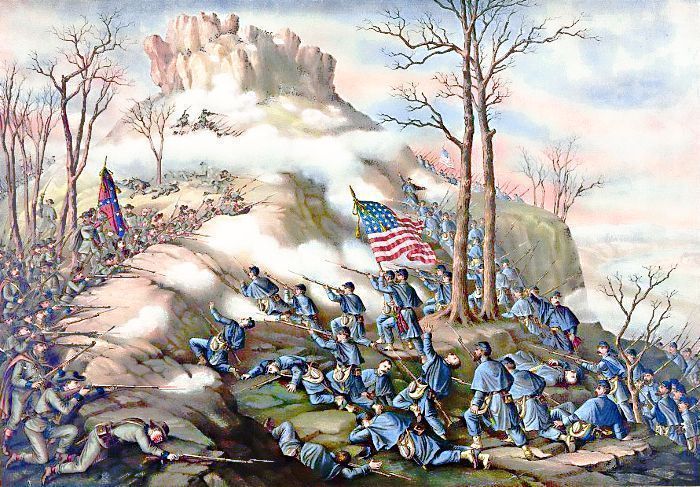
Union Army General Charles Ewing and foster brother of William Tecumseh Sherman died June 20th 1893.
Charles Ewing was born March 6th 1835 the son of Thomas Ewing, the United States Interior Secretary. He received an education at the Dominican College and the University of Virginia, where he studied law. Ewing was practicing law in St Louis, Missouri when the Civil War broke out.
In 1861 Ewing received a commission in the 13th infantry as Captain under his brother-in-law William T Sherman. He was wounded at the Battle of Vicksburg while placing the company flag on the Confederate fort. He received brevets for his actions at Jackson, Missionary Ridge and the Atlanta campaign. Ewing was made Brigadier General of volunteers March 8th 1865.
After the end of the war Ewing resigned his commission in 1867 and returned to law, practicing in Washington, DC. In 1874 he served as the Catholic Commissioner for Indian Missions. He died in Washington, DC June 20th 1883.
Showing posts with label Missionary Ridge. Show all posts
Monday, June 20, 2011
Friday, January 7, 2011
He Ran Stores And Led Men
Union Brigadier General Samuel Emerson Opdycke was born January 7th 1830.
Samuel Emerson Opdycke was born on a farm in Hubbard, Ohio January 7th 1830. He came from a family with a long military history. Opdycke attended local schools, and then operated various businesses in Ohio. He went to California during the Gold Rush and opened a mercantile store.
Shortly after the First Battle of Bull Run, Opdycke enlisted in the Union army as a First Lieutenant in the 41st Ohio Infantry. He saw action with the 41st at the Battle of Shiloh. Opdycke resigned and went back to Ohio in September 1862 to recruit the 125th Ohio Infantry. He was there as a Colonel when the 125th saw action at Horseshoe Ridge during the Battle of Chickamauga. Opdycke and the 125th were also present at Missionary Ridge, the Battle of Chattanooga and Battle of Resaca where he was badly wounded in the arm. Opdycke had recovered enough to be at the head of his men during the Battle of Kennesaw Mountain, and at the Battle of Franklin. He received a promotion to Brigadier General July 26th 1865. Opdycke resigned from the army in 1866.
Following the war Opdycke moved to New York City. He opened a dry good store, was active with veterans affairs, and wrote about the war. While he was cleaning a pistol, Opdycke accidentally shot himself in the stomach. He died April 25th 1884 and is buried in the Oakwood Cemetery in Warren, Ohio.
Samuel Emerson Opdycke was born on a farm in Hubbard, Ohio January 7th 1830. He came from a family with a long military history. Opdycke attended local schools, and then operated various businesses in Ohio. He went to California during the Gold Rush and opened a mercantile store.
Shortly after the First Battle of Bull Run, Opdycke enlisted in the Union army as a First Lieutenant in the 41st Ohio Infantry. He saw action with the 41st at the Battle of Shiloh. Opdycke resigned and went back to Ohio in September 1862 to recruit the 125th Ohio Infantry. He was there as a Colonel when the 125th saw action at Horseshoe Ridge during the Battle of Chickamauga. Opdycke and the 125th were also present at Missionary Ridge, the Battle of Chattanooga and Battle of Resaca where he was badly wounded in the arm. Opdycke had recovered enough to be at the head of his men during the Battle of Kennesaw Mountain, and at the Battle of Franklin. He received a promotion to Brigadier General July 26th 1865. Opdycke resigned from the army in 1866.
Following the war Opdycke moved to New York City. He opened a dry good store, was active with veterans affairs, and wrote about the war. While he was cleaning a pistol, Opdycke accidentally shot himself in the stomach. He died April 25th 1884 and is buried in the Oakwood Cemetery in Warren, Ohio.
Wednesday, November 24, 2010
Above The Clouds
The Battle of Lookout Mountain, near Chattanooga, Tennessee was fought November 24th 1863.
Lookout Mountain is known for unique weather, in which fog covers the valley about half way down the mountain. This weather caused the battle fought November 24th 1863 on Lookout Mountain, to also be known as the Battle Above the Clouds. With 12,000 men located west of Chattanooga, Union General Joseph “Fighting Joe” Hooker crossed Lookout Mountain Creek advancing through a thick mist, they found about 1,200 Confederates entrenched on the side of Lookout Mountain. The Confederates under the command of Major General Carter L Stevenson, began a fighting withdrawal toward the northern face of Lookout Mountain. Hooker ordered artillery to fire on the Confederate line of retreat, but the effect was minimal do the poor visibility. Heavy fighting took place at Cravens House on the sheer north slope of the mountain.
Confederate General Braxton Bragg ordered an withdrawal of the men on the Mountain. They were to join up with him on Missionary Ridge for a battle that would take place the next day. The Union held Lookout Mountain with the loss of 629 men, 81 of which were deaths.
Lookout Mountain is known for unique weather, in which fog covers the valley about half way down the mountain. This weather caused the battle fought November 24th 1863 on Lookout Mountain, to also be known as the Battle Above the Clouds. With 12,000 men located west of Chattanooga, Union General Joseph “Fighting Joe” Hooker crossed Lookout Mountain Creek advancing through a thick mist, they found about 1,200 Confederates entrenched on the side of Lookout Mountain. The Confederates under the command of Major General Carter L Stevenson, began a fighting withdrawal toward the northern face of Lookout Mountain. Hooker ordered artillery to fire on the Confederate line of retreat, but the effect was minimal do the poor visibility. Heavy fighting took place at Cravens House on the sheer north slope of the mountain.
Confederate General Braxton Bragg ordered an withdrawal of the men on the Mountain. They were to join up with him on Missionary Ridge for a battle that would take place the next day. The Union held Lookout Mountain with the loss of 629 men, 81 of which were deaths.
Subscribe to:
Posts (Atom)