Showing posts with label Braxton Bragg. Show all posts

Wednesday, November 27, 2013

If I Had A Thousand Lives

Sam Davis known as the “Boy Hero of the Confederacy” was executed on November 27th 1863.

Sam Davis was born October 6th 1842 in Rutherford County, Tennessee, the son of Charles Lewis and Jane (Simmons) Davis.  He attended local schools, before going to the West Military Institute in Nashville, Tennessee in 1860-61, where his headmaster was the future Confederate General Bushrod Johnson.

At the beginning of the Civil War Davis enlisted as a private in the Confederate 1st Tennessee Infantry.  He would see his first action at Cheat Mountain in the Shenandoah Valley.  Davis was wound at the Battle of Shiloh and again at the Battle of Perryville.  The Perryville wound was serious, and after recovering he became a courier for Coleman’s Scouts.


It was while doing service with Coleman’s Scouts that Davis was captured on November 20th 1863 near Minor Hill, Tennessee.  He was wearing a partial Confederate uniform, had a pass from Confederate General Braxton Bragg and was in possession of Union papers detailing troop movements and private papers belong to Union General Grenville M Dodge.  Davis was arrested as a spy, and sentenced by a military court to be executed by hanging.  He was given an out, if he would name his Union contact, to which Davis was supposed to have said, "If I had a thousand lives to live, I would give them all rather than betray a friend or the confidence of my informer.”  Just before the execution Davis wrote a letter home to his family, "Dear mother. O how painful it is to write you! I have got to die to-morrow --- to be hanged by the Federals. Mother, do not grieve for me. I must bid you good-bye forevermore. Mother, I do not fear to die. Give my love to all.  Father, you can send after my remains if you want to do so. They will be at Pulaski, Tenn. I will leave some things with the hotel keeper for you."  He was hung November 27th 1863 at Pulaski, Tennessee.

Monday, June 24, 2013

Holding The Gaps

George H Thomas
The Battle of Hoover’s Gap a part of the Middle Tennessee Campaign was fought June 24th 1863.

After the Battle of Stones River, Confederate General Braxton Bragg established a line from Shelbyville to Wartrace along the Duck River, this included holding the Bellbuckle, Hoover’s and Liberty Gaps.  Union leaders fearing that Bragg would go to the support of Vicksburg pushed Major General William Rosecrans to attack Bragg’s position.

Rosecrans made a move towards Shelbyville on June 23rd 1863 to get Bragg’s attention, while the mass of his troops headed for the Gaps.  On June 24th 1863 Union Major General George H Thomas attacked Hoover’s Gap.  Thomas used Colonel John T Wilder’s mounted infantry known as the “Lightning Brigade” armed with Spencer Rifles to spearhead the attack.  They met Confederate Colonel J Russell Butler’s 1st Kentucky Cavalry, and pushed them back 7 miles, before Wilder’s men came up against Brigadier General William B Bate’s brigade.  Wilder entrenched on the hills to the south of the gap and held throughout several Confederate attacks.  More units arrived on both sides and everyone settled down hold their position.

On June 26th 1863 the Confederate force began pulling back.  Although rain made moving slow Rosecrans pushed Bragg’s men until they fell back to a defensive line at Tullahoma.

Sunday, March 10, 2013

One Last Fight

The Battle of Wyse Fork [aka the Battle of Southwest Creek], a part of the Carolina Campaign ramped up again on March 10th 1865.

The city of Wilmington, North Carolina fell into Union hands in February 1865.  Union Major General John M Schofield moved in from the coast and joined his force with Major General William T Sherman at Goldsboro, North Carolina where they would move against Confederate General Joseph E Johnston’s army.

As the Union troops advanced they encountered Confederate General Braxton Bragg who was entrenched along the Southwest Creek near Kinston, North Carolina on March 7th 1865.  Bragg’s position threatened a cross road and the New Bern Goldsboro Railroad.  Bragg moved to the offensive and sent Confederate General Robert Hoke into the Union left flank.  On March 8th 1865 he crossed the creek about noon and slammed into the Union flank and rear and captured about 1,500.  After an active advance by the Confederates the two sides settled into skirmishing for the next couple of days.

Hoke again tried to turn the Union left flank on March 10th 1865.  The Union position had been strongly fortified and they repulsed Hoke’s men within about an hour.  Confederate General Daniel Harvey Hill then made a moved on the Union center, but again they were repulsed by Union artillery.  At this point remaining members of the Union XXII corps arrived from Tennessee, and finding himself facing five Union divisions, Bragg had his men withdrawn.

Tuesday, December 18, 2012

A Northern Born Confederate

Northern born and raised, Confederate Brigadier General Johnson Kelly Duncan died December 18th1862 from malaria fever.

Johnson Kelly Duncan was born in Chanceford, York, Pennsylvania March 19th 1827.  He received an appointment to the United States Military Academy, graduating 5th out of the class of 1849.  He started his military career as a Second Lieutenant in the Third Artillery with fighting against the Seminole Indians in Florida.  In 1855 with the rank of First Lieutenant, Duncan left the army and moved the Louisiana.  He worked in New Orleans as an architect, surveyor and the Chief Engineer of the Board of Public Works.

When the Civil War started Duncan sided with those of his southern home, and enlisted in the Confederate service, becoming the Colonel of the 1st Louisiana Artillery.  He was promoted to Brigadier General January 7th 1862, and placed in command of the defenses of the Lower Mississippi.  When Union Admiral David Farragut captured Fort Jackson on April 28th 1862, Duncan became a prisoner of war.  After a prisoner exchange on August 27th 1862, Duncan was assigned to Confederate General Braxton Bragg as his Chief of Staff.  While on this duty, he contracted Malarial and died December 18th 1862 in Knoxville, Tennessee. Duncan is buried in the Confederate Cemetery in Franklin, Tennessee.

Saturday, December 8, 2012

The First Dragoons Form

The Prattville Dragoons were organized December 8th 1860 in Autauga County, Alabama.

The original idea for forming a company was made by Samuel D Oliver of Robinson Springs, Alabama.  The Prattville Dragoons were organized December 8th 1860 in the parlor of George L Smith at Prattville, Alabama.  Each member of the company was presented with a cavalry uniform, made of black broadcloth with gold trim.  Their first Captain, as voted by the men was Jesse Cox of Mobile, Alabama.  There were 18 officers, 82 privates and 2 black cooks.  The men formed for their send off at the Prattville Academy, where they were presented with a silk flag, hand sown by the ladies of the town.

The Dragoons moved to camp in Pensacola, Florida were they were placed under Confederate General Braxton Bragg.  The men were issued arms and became a mounted unit, Company I of the 7th Alabama Infantry.  They took part in the Battle of Shiloh in April 1862.  In June 1862 most of the men reenlisted, becoming part of Company H of the 3rd Alabama Cavalry.  They saw action throughout the rest of war particularly at Barmlet’s Station and the Battle of Perryville.

The regiment reduced by heavy losses surrendered in North Carolina on April 26th 1865, as a part of Confederate General Joseph E Johnston army.

Tuesday, November 27, 2012

Hold That Gap At All Hazards

The Battle of Ringgold Gap, a Confederate victory was fought November 27th 1863 in northwest Georgia.

The Battle of Missionary Ridge was disastrous to the Confederate Army of Tennessee and sent them limping into northwest Georgia.  Reaching the mountain pass of Ringgold Gap, Confederate General Braxton Bragg, needed time to get his wagons and artillery; which were bogged down on the muddy roads through, so he called on Major General Patrick Cleburne to hold the pass from the Union army “at all hazards, and keep back the enemy until the artillery and transportation” are secure.  Ringgold Gap was a narrow railroad cut used by the Western & Atlantic just outside the town of Ringgold, Georgia.

Cleburne’s men opened the battle with artillery about 3 am surprising Union Major General Joseph Hooker’s following force.  Hooker tried to regain the initiative attempting to outflank the Cleburne’s position.  Cleburne held his ground with two cannon and 4,100 men for five hours, not giving Hooker or his 12,000 soldiers any ground.  The Confederate wagons and artillery having made it through the Gap, at about noon Cleburne managed a successful retreat.  It was a costly fight for both sides, with the Confederates loosing 480 men and the Union 432.

Friday, November 23, 2012

Houses Trembled Ten Miles Off

Fort McRee located on the eastern tip of Perdido Key, Florida was continued to be fired on, on November 23rd 1861 by Union batteries and the USS Niagara.

Fort McRee was a bent elliptical fort built on a barrier island.  At its widest points the fort was 450 feet by 150 feet wide.  The wall that faced the channel was 366 feet long and about 35 feet above the water line during low tide.  McRee held 128 cannons, including twenty-four 32 pounders.  The fort was built before 1839 by William Henry Chase who oversaw the construction of all the Pensacola area forts.
In early January 1861 Union troops located at Fort McRee destroyed about 20,000 pound of gunpowder and evacuated to Fort Pickens.  On January 12th 1861 Confederate troops from Alabama and Florida occupied McRee.

On the morning of November 22nd 1861 Union batteries located at Fort Pickens opened on some Confederate steamers docked at the Navy Yard.  The ships escaped with very little damage, while the Confederate guns located at Forts Barrancas and McRee returned fire on Fort Pickens.  The USS Richmond and USS Niagara moved in firing on Fort McRee, shooting the Fort’s flagstaffs off.  The Confederate fire was able to do some damage to the USS Richmond.  Confederate General Braxton Bragg said of that day's battle, that "the houses in Pensacola, ten miles off, trembled from the effect; and immense quantities of dead fish floated on the surface of the lagoon, stunned by the concussion."  At about 5 pm with the tide going out the two Union ships had to withdraw and the guns of McRee fell silent.
The Battle took up again on November 23rd 1861 where it had left off.  The Union side firing around 5,000 rounds of ammo into Fort McRee did extensive damage.  Fort McRee’s Confederate commander Colonel John B Villepique sent word to Bragg that the fort was exposed, half his guns had been dismounted and the powder was in danger.  The Confederate only returned about 1,000 shots, killing 2 and wounding 13 Union men.  Fort McRee would survive the bombardment, but large chunks of wall were blown away or collapsed, and one powder magazine caved in.  Six Confederate soldiers died in the action.

Wednesday, August 29, 2012

Opening Up Kentucky

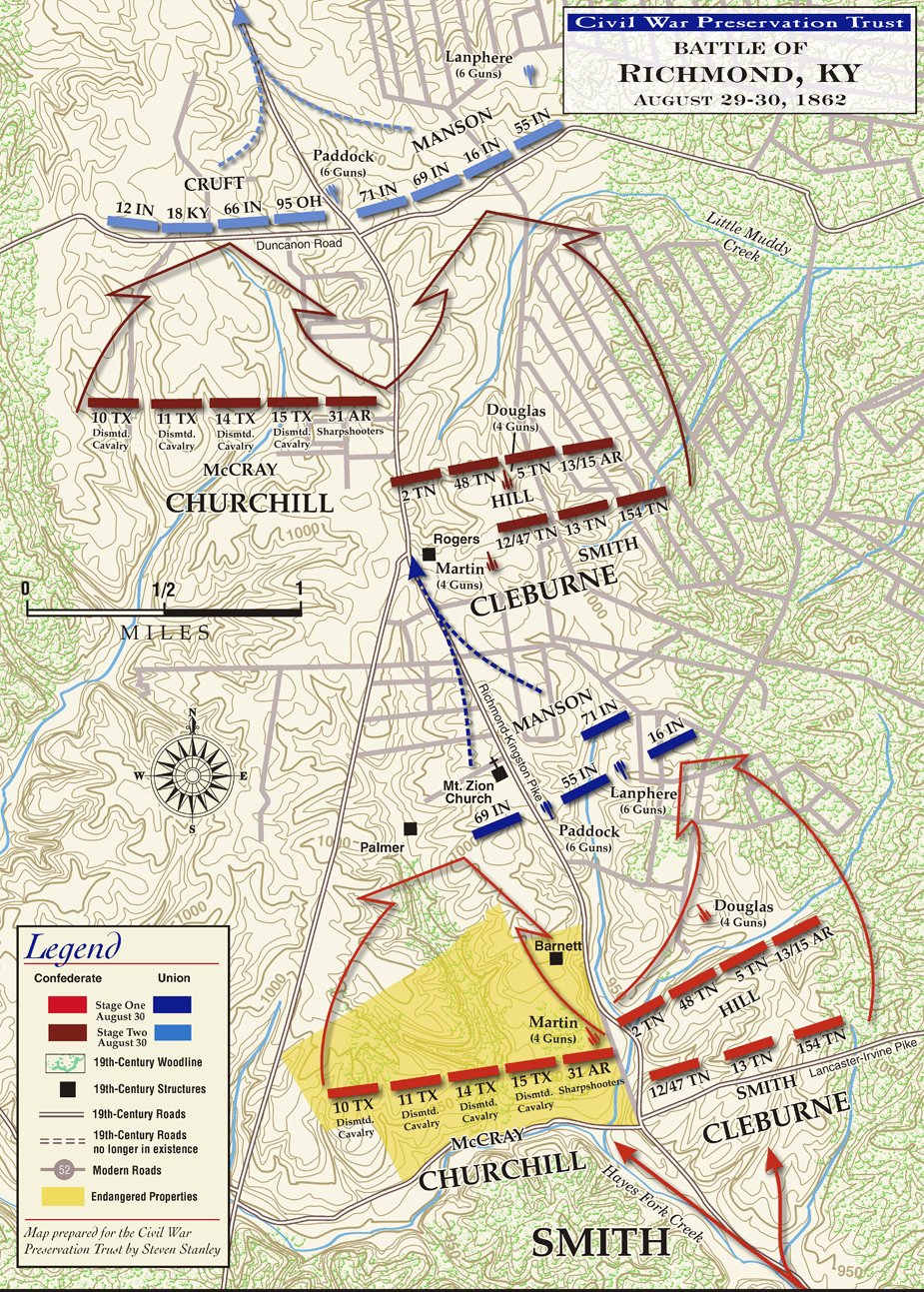
A Confederate victory the Battle of Richmond was fought August 29th and 30th 1862 in the Richmond, Kentucky area.

In August 1862 two Confederate armies moved into Kentucky looking to threaten Union areas along the Ohio River and do some recruiting.  These were commanded by Brigadier General Edmund Kirby Smith and Major General Braxton Bragg.  They moved more or less parallel across the state, with Smith moving from Knoxville and Bragg from Chattanooga.

Smith’s men moved north on August 29th 1862 from Big Hill, Kentucky toward Richmond, Kentucky, where they met Union skirmishers.  Shortly after noon Union artillery and infantry came up, forcing Smith’s cavalry under Confederate Colonel John S Scott to retreat back to Big Hill.  Union troops in the area were commanded by Brigadier General Mahlon Dickerson Manson, and they pursued and skirmished with the Confederates into the late afternoon.  That night Manson reported to his commander Major General William Bull Nelson.

The fighting continued the next day with each bringing in more troops.  In the end the Union troops retreated.  The Confederates captured about 4,300 Union men.  The Union also had 78 men killed and 372 wounded and 1 missing.  This battle laid open the way for the Confederate to move north towards Lexington and Frankfort.

Saturday, March 31, 2012

Struck Down By A fever

Confederate General John Bordenave Villepigue resigned his commission with the Union army on March 31st 1861.

John Bordenave Villepigue was born July 2nd 1830 in Camden, Kershaw, South Carolina.  He attended the South Carolina Military Academy in 1846, the Citadel in 1847 and finally graduated from the United States Military Academy at West Point in 1854, the 2nd in his class.  Villepigue’s first duty as a Second Lieutenant was with the 2nd United States Dragoons.  He saw action in Kansas and Nebraska against the Sioux, and was part of the Utah campaign in 1857.  Promoted to First Lieutenant he taught for a time at the Carlisle Cavalry School in Pennsylvania.

Villepigue was on duty in Utah when the Civil War started, he resigned his commission in the Union Army March 31st 1861.  He took a commission in the Confederate Army of Captain of artillery.  In a short time Villepigue was promoted to Colonel in the 36th Georgia Infantry, and he took command of Fort McRee in time for the bombing on November 22nd 1861, where he was seriously wounded.  Serving under Confederate General Braxton Bragg; who praised him for his leadership, Bragg said Villepigue was "an educated soldier, possessing in an eminent degree the love and confidence of his officers and men, he had been specially selected for this important and perilous post."  He moved onto Mobile, Alabama and received an appointment to Brigadier General in 1862.  Villepigue commanded a brigade at the Second Battle of Corinth in October 1862, serving under Confederate Major General Earl van Dorn.

Villepigue caught a fever during the campaign.  He was sent to Port Hudson, Louisiana to recuperate, but developed pneumonia and died November 9th 1862.  He is buried in the Old Quaker Cemetery in Camden, South Carolina.

Thursday, October 27, 2011

Across The River At Brown's Ferry

Fought in Hamilton County, Tennessee, the Battle of Brown’s Ferry took place October 27th 1863.

After the Union defeat at the Battle of Chickamauga, the Army found itself trapped by Confederate General Braxton Bragg’s Army of Tennessee in Chattanooga, Tennessee.  Bragg settled in, to siege the Union position.  He sent Confederate Brigadier General Evander Law downstream, where Law was to stop any Union supply trains.  Union commander Brigadier General William S Rosecrans telegraphed Washington to say, "We have no certainty of holding our position here."  In response Washington sent reinforcements under the command of General Ulysses S Grant.

Grant started on October 26th 1863 to open a supply route from Brown’s Ferry to Chattanooga.  The planned route was designed by Chief Engineer, Brigadier General William F "Baldy" Smith.  The new supply line was named the “Cracker Line”, by soldiers who were running low on food.  Smith’s two brigades under Brigadier Generals William B Hazen and John B Turchin would split, with Turchin’s men marching across land to hold Brown’s Ferry, while Hazen’s would ferry down the river in pontoon boats.

Hazen’s troops made the landing point at 5 am on October 27th 1863.  Although they were moving quietly some of the men were fired on by Confederate pickets.  The Confederates quickly formed for an attack, however at this time Turchin’s men were being ferry across the river.  The combined force of Union men outflanked the Confederate soldiers who withdrew toward Wauhatchie.  By latter that afternoon the 1st Michigan Engineers had a pontoon bridge across river and open.

Monday, May 2, 2011

The Last House Of The Confederacy

The Burt - Stark Mansion in Abbeville, South Carolina was the site on May 2nd 1865 of the last Confederate Council of War meeting.


The original owner of the Burt - Stark Mansion was David Lesley. He hired an English landscaper to design the property. When Lesley died in 1855, the property was purchased by a Presbyterian minister, Thomas A Hoyt. Hoyt sold it to Andrew Simonds a banker from Charleston, South Carolina, who in turn sold the home to Armistead Burt. Jefferson Davis’ wife Varina had met Burt when her husband was first in the United States Congress in 1845. At the beginning of the Civil War the first reading of the South Carolinia secession papers happened in the Burt - Stark Mansion. When Richmond, Virginia became un-safe Varina Davis and her children were invited by Burt to his home on April 17th 1865. After Richmond fell Jefferson Davis went to the house.

In the early evening of May 2nd 1865 Jefferson Davis held his final war council in the Burt - Stark Mansion. Among those who were in attendance were the Secretary of War John C Breckinridge and Braxton Bragg. Davis argued to continue fighting using the Confederate forces located west of the Mississippi River, but he was only one in favor. After some seething Davis excepted the decision, effectively bring an end to the Confederate States of America.

Saturday, April 30, 2011

A Long Running Raid

Col Abel D Streight
The first of a series of skirmishes known as Streight’s Raid, the Battle of Day’s Gap was fought on April 30th 1863 in Cullman County, Alabama.

The goal of Union Colonel Abel D Streight’s Raid was to cut off the Western & Atlantic Railroad, interrupting Confederate General Braxton Bragg’s supplies. Streight’s force made up of the 80th Illinois, 51st and 73rd Indiana, 3rd Ohio Infantry and 1st Middle Tennessee Cavalry, left Nashville, Tennessee and moved first to Eastport, Mississippi, then to Tuscumbia, Alabama. Leaving Tuscumbia on April 26th 1863 his march south was screened by Union Brigadier General Grenville M Dodge.

At Day’s Gap on the Sand Mountain, Confederate General Nathan Bedford Forrest attacked Streight’s rearguard on April 30th 1863. The Union troops held off the attack and continued the march to avoid further envelopment. This battle set in motion a series of engagements including Crooked Creek and Hog Mountain the same day. Streight’s Raid came to end on May 3rd 1863 when Forrest surrounded the exhausted Union troops about three miles from Cedar Bluff, Alabama, where they surrendered. Streight was sent to Libby Prison in Richmond, Virginia, which he escaped from on February 9th 1864.

Sunday, February 6, 2011

Only Married Aout Three Weeks

The first former United States officer to be captured as a Confederate; Brigadier General John Pegram was killed February 6th 1865.

John Pegram was born January 24th 1832 in Petersburg, Virginia the son of John West and Virginia [Johnson] Pegram. His father died when he was still young, and his mother supported the family by running a girls school. Pegram received an appointment to the United State Military Academy at West Point. He graduated in 1854, and was assigned to the United State dragoons as a Second Lieutenant. After three years of garrison duty in the West, Pegram was appointed as Assistant Instructor of Cavalry at West Point. He took a leave in 1858-59 to go to Europe and observe the Austro - Sardinian War. After returning from Europe in 1860 Pegram was assigned on the frontier in New Mexico Territory.

Pegram received news in May 1861 that his home state of Virginia had seceded. He resigned his Untied State Lieutenant commission. In July of 1861 Pegram was assigned to the 20th Virginia Infantry and commissioned a Lieutenant Colonel. The 20th Virginia was part of Brigadier General Robert Selden Garnett’s brigade serving in western Virginia. In August 1861 Pegrem’s men were cut off from the brigade during the Battle of Rich Mountain on July 11th 1861, and Pegram surrendered his men to the Union forces. Making Pegram the first former United States Army officer to be captured as a Confederate, he spent six months imprisoned in Fort Monroe. Paroled on January 1862, Pegram was prompted to Colonel and made the Chief Engineer of the army of General Braxton Bragg. In November 1862 Pegram was promoted to Brigadier General and given command of a Cavalry Brigade. In November 1862 he reported to the Army of Northern Virginia, where he was given command of a brigade in Jubal A Early’s division. Pegram was wounded during the Battle of the Wilderness, but was back in time for Early’s Valley Campaign.

Pegram married Hetty Cary January 19th 1865 in Richmond, Virginia. The wedding was attended by Confederate President and Mrs Jefferson Davis. Pegram was killed in action February 6th 1865 at the Battle of Hatcher’s Run. His funeral would be held in the same church he was just married in. Pegram is buried in the Hollywood Cemetery in Richmond, Virginia.

Wednesday, November 24, 2010

Above The Clouds

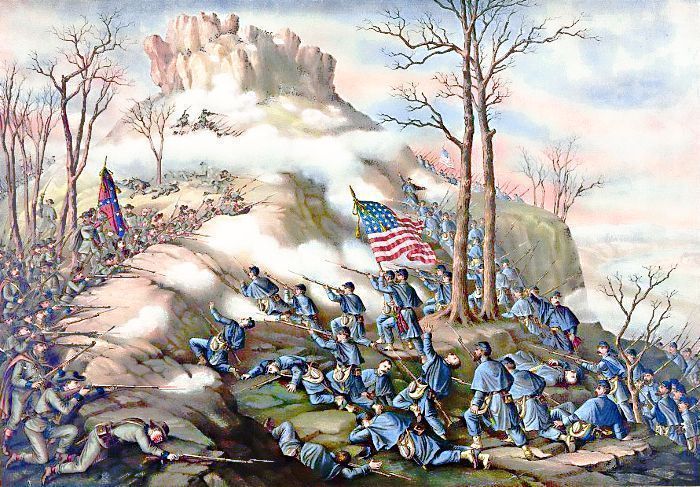
The Battle of Lookout Mountain, near Chattanooga, Tennessee was fought November 24th 1863.


Lookout Mountain is known for unique weather, in which fog covers the valley about half way down the mountain. This weather caused the battle fought November 24th 1863 on Lookout Mountain, to also be known as the Battle Above the Clouds. With 12,000 men located west of Chattanooga, Union General Joseph “Fighting Joe” Hooker crossed Lookout Mountain Creek advancing through a thick mist, they found about 1,200 Confederates entrenched on the side of Lookout Mountain. The Confederates under the command of Major General Carter L Stevenson, began a fighting withdrawal toward the northern face of Lookout Mountain. Hooker ordered artillery to fire on the Confederate line of retreat, but the effect was minimal do the poor visibility. Heavy fighting took place at Cravens House on the sheer north slope of the mountain.

Confederate General Braxton Bragg ordered an withdrawal of the men on the Mountain. They were to join up with him on Missionary Ridge for a battle that would take place the next day. The Union held Lookout Mountain with the loss of 629 men, 81 of which were deaths.

Monday, November 15, 2010

He Left West Point

Confederate Major General Pierce Manning Butler Young was born November 15th 1836.


Pierce Manning Butler Young the son of doctor R M Young, was born November 15th 1835 in Spartanburg South Carolina. The family moved when Young was a child to Cartersville, Bartow County Georgia, where his father hired private tutors for his children. At thirteen he began attending Georgia Military Institute, then in 1857 Young received an appointment to the United State Military Academy at West Point. He was a few months short of graduation in 1861, when Georgia seceded and he resigned.

Young was appointed Second Lieutenant in the 1st Georgia Infantry, upon his return home. In July he was attached to Confederate General Braxton Bragg’s staff. By November Young was a Lieutenant Colonel and commanding cavalry in Cobb’s Legion. His unit was attached to Wade Hampton’s brigade which was part of JEB Stuart’s cavalry. Young was promoted to Colonel for service at the Battle of Brandy Station and Huntertown Pennsylvania, which was part of the Gettysburg campaign. He was wounded in August 1863, and promoted to Brigadier General shortly after, Young took over command Hampton’s brigade. The brigade saw more action at Bristoe Station and in the Mine Run Campaign. Young’s final promotion came in December 1864 while in defense of Savannah to Confederate Major General.

Following the Civil War Young returned to Georgia and took up the life of a planter. He served four terms in the United State House of Representatives, as a consul-general in Russia and the Untied States Minister to Honduras and Guatemala. Young died in New York City July 6th 1896.

Sunday, November 14, 2010

They Hunted Jefferson Davis

The Union 12th Ohio Cavalry mustered out of service in Nashville, Tennessee November 14th 1865.

The 12th Ohio Cavalry was mustered in November 24th 1863 at Camp Taylor in Cleveland, Ohio. They were placed for three years under the command of Colonel Robert W Ratliff. The regiment was part of the 2nd Brigade, 5th Division of the 23rd Corps, District of Kentucky, the Department of Ohio. They saw service during John Hunt Morgan’s invasion at Mount Sterling, General Stephen Gano Burbridge’s raid on Saltville and during Stoneman’s Raid as well as others. Following Robert E Lee’s Surrender at Appomattox, the 12th Ohio took part in the man hunt for Jefferson Davis. They captured Confederate Generals Braxton Bragg. The 12th Ohio was mustered out November 14th 1865 in Nashville, Tennessee. The regiment saw 50 men killed or mortally wounded and 112 who died from disease.

Friday, October 8, 2010

Control Of Kentucky

The Battle of Perryville, also sometimes called the Battle of Chaplin Hills was fought October 8th 1862 in Perryville, Kentucky.


Union General Don Carlos Buell’s Army of the Ohio with about 55,000 troops, converged on the town of Perryville, Kentucky pursuing Confederate General Braxton Bragg and his Army of Mississippi. The fighting began at dawn October 8th 1862 along the Peters Hill. After noon a Confederate division hit the Union left flank of Major General Alexander M McCook, causing it to fall back. The Union troops formed a line and made a stand, but with more Confederate soldiers coming up the Federal force was routed. Buell was several miles behind the action, and wasn’t aware there was a fight taking place. Once he realized there was a battle taking place he sent in reserves. Two brigades prompted up the Union left flank, halting the Confederate attack.

Following this three regiments of Confederates hit a Union division along the Springfield Pike, finding themselves overwhelmed the Confederates fell back to Perryville. Union troops gave chase, and there was fighting in the streets until darkness fell. By this time there were more Union reinforcement, and Bragg who was short on supplies and man power pulled out during the night, retreating through the Cumberland Gap to Fort Tennessee. This battle left the Union in control of the border state of Kentucky.

For more information about this battle check out this web site The Battle of Perryville

Thursday, November 26, 2009

Hold The Union And Buy Some Time

Maj Gen Patrick Cleburne
To gain a little time, the Confederates held up Hooker’s Union forces on November 26th 1863 at the Battle of Ringgold Gap.

Confederate General Braxton Bragg’s troops were stretched out for over 15 miles after the Battle at Missionary Ridge. Union Major General Joseph Hooker was right behind them. Looking to gain a little time, Bragg chose Major General Patrick Cleburne. As Bragg went through the city of Ringgold he sent orders to Cleburne to cover the Confederate retreat until they could reorganize in Dalton, Georgia.

At 3 am on November 26th 1863 as Cleburne and his men marched towards Ringgold, they passed through the gap where the Western and Atlantic Railroad drops towards Atlanta. Cleburne had men and two cannons placed in that gap, where they could watch the Union troops approaching. The Confederate troops held their fire until the Union troops were in the gap. The volley sent a withering fire and the soldiers retreated. Hooker decided to try the flanks of Confederate force, but Cleburne anticipated this and moved his troops, repulsing the Union attacks. The Battle continued for five hours.

Bragg had by this time reorganized at Dalton, Georgia and sent orders to Cleburne to join him there. Cleburne with just 4100 Confederate soldiers held off Hooker’s 12,000 Union troops. Although Hooker reported his losses at less than 500 men, descriptions of the battlefield indicate losses were higher. General Ulysses S Grant noted this on the bottom of report filed by Hooker.

Saturday, September 19, 2009

An Acoustical Shadow

The Confederate Army of the West found themselves in the Battle of Iuka on September 19th 1862.

Confederate Major General Sterling Price’s main column arrived in Iuka, Mississippi on September 14th 1862. He had been ordered by his commander General Braxton Bragg to keep the Union army in Mississippi from moving into Tennessee.

Union General William Rosecrans began his march to Iuka, Mississippi at 4:30 am on September 19th 1862. Price had planned to rendezvous with General Earl Van Dorn, but saw that he could not evacuate Iuka at that time. As Rosecrans’s men advanced they fought an action with the Confederates along the route. At about 4pm the Union column halted on the top of a hill, because the Confederates were in the ravine below which was filled with trees and underbrush. The Confederate troops embarked on an attack up the hill, where they took an Ohio battery. The fighting went on until dark. Although by all accounts the fighting was heated, an acoustical shadow kept all sound from the battle from being heard just two miles away where other Union troops were located. Rosecrans’ men camped behind the ridge and Price redeployed his troops across their front.

Following the 19th’s battle Price planned to reengage the enemy, but his subordinates convinced him to join his army up with Van Dorn. The Union army occupied Iuka, before making a pursuit on September 20th 1862. The Confederate rearguard and a heavily overgrown terrain prevented the chase from amounting to much. The Union saw casualties of about 800 killed, wounded or missing. The Confederate side saw about 1500 casualties from the battle.

Sunday, March 22, 2009

Bragg

In Warren County, NC Braxton Bragg was born on March 22nd 1817.

He graduated from West Point in 1837, the fifth in his class. He saw service with the US military in War with Mexico, and the Seminole war. In 1861 he was put in charge of the Army of Louisiana and was made Brigadier General in the Confederate Army in March of that year. He fought in many battles including Shiloh, and Chickamauga. Confederate President Jefferson Davis assigned him to duty in Richmond, VA in February 1864. In November of that year he was placed in command of the Department South Carolina, holding his army that winter at Wilmington, NC. He was in command of troop during the final battle with General William Tecumseh Sherman. After Robert E Lee’s surrender at Appomattox Bragg accompanied Jefferson Davis on his attempted escape.

After the war he was Chief Engineer for the state of Alabama. He died in Galveston, TX September 27th 1876 where he was working as an inspector for a railroad. US Army Fort Bragg in North Carolinian was named in his honor.

Some other information
Braxton Bragg and Confederate Defeat