Arlington National Cemetery was officially created as a military cemetery June 15th 1864.
Arlington National Cemetery was established on the grounds of Arlington House. Arlington House was an estate owned by Confederate General Robert E Lee’s wife Mary Anna [Custis] Lee, the grand-daughter of Martha Washington. The Custis family bought the land where the cemetery is located in 1802 and began building Arlington House.
The United States government purchased Arlington House and its two hundred acres at a tax sale for $26,800 in 1864. Mrs. Lee sent an agent to pay the $92.07 property taxes that were due, but the government refused to take the payment which was not made in person. The United States Soldiers’ National Cemetery in Washington DC was rapidly filling with military burials, so United States Quartermaster General Montgomery C Meigs wrote of Arlington that the “grounds about the mansion are admirably adapted to such a use." United State Secretary of War Edwin M Stanton officially had the land set aside as a military cemetery June 15th 1864. Burials were begun on the ground of Arlington House before the ink had time to dry.
Custis Lee the son of Robert E Lee sued the United State for ownership of Arlington House in 1874, claiming the estate was held in trust for his mother. The United States Supreme Court ruled in Lee’s favor and Congress returned the land to him. The next year, 1875 Lee sold the property back to the government for $150,000 at a ceremony with Robert Todd Lincoln. President Herbert Hoover held the first official National Memorial Day May 30th 1929 in Arlington National Cemetery.
This is a must read web site for information about the Arlington National Cemetery
Showing posts with label Arlingotn National Cemetery. Show all posts
Wednesday, June 15, 2011
Saturday, December 11, 2010
The Father Of Battlefield Medicine
Jonathan Letterman the “Father of Battlefield Medicine”, a Union surgeon during the Civil war was born December 11th 1824.
Jonathan Letterman was born December 11th 1824 in Canonsburg, Pennsylvania, the son of a surgeon. He graduated from Jefferson Medical College in 1849. That same year Letterman excepted a position as assistant surgeon of the United States Army Medical Department. He served during the Seminole Indian Campaign in Florida, at Fort Ripley, Minnesota, Fort Defiance in the New Mexico Territory, Fort Monroe, Virginia, and in California through 1861.
At the beginning of the Civil War, Letterman was assigned to the Union Army of the Potomac, with the rank of Major. Receiving permission from Major General George B McClellan, Letterman reorganized the Medical Service. The Union Army was grossly inefficient in handling casualties from the Seven Days Battle, and Letterman saw the need for changes. By the Battle of Antietam, he had set up regimental aid stations, the use of triage, field hospitals, and an ambulance corps. The system was so proficient that an Act of Congress in March 1864 established it as the Union Armies medical procedure. The Battle of Gettysburg in July 1863 left over 20,000 Union and Confederate wounded, and the vast medical encampment set up on the George Wolf farm was named for Letterman.
Letterman ended his military service as the Inspector of Hospitals, he resigned in December 1864. He moved to San Francisco, California where he was a coroner until 1872. He wrote a memoir in 1866, “Medical Recollections of the Army of the Potomac”. Following the death his wife, Letterman became quite sick, and died March 15th 1872 in San Francisco, California. He is buried in Arlington National Cemetery.
Jonathan Letterman was born December 11th 1824 in Canonsburg, Pennsylvania, the son of a surgeon. He graduated from Jefferson Medical College in 1849. That same year Letterman excepted a position as assistant surgeon of the United States Army Medical Department. He served during the Seminole Indian Campaign in Florida, at Fort Ripley, Minnesota, Fort Defiance in the New Mexico Territory, Fort Monroe, Virginia, and in California through 1861.
At the beginning of the Civil War, Letterman was assigned to the Union Army of the Potomac, with the rank of Major. Receiving permission from Major General George B McClellan, Letterman reorganized the Medical Service. The Union Army was grossly inefficient in handling casualties from the Seven Days Battle, and Letterman saw the need for changes. By the Battle of Antietam, he had set up regimental aid stations, the use of triage, field hospitals, and an ambulance corps. The system was so proficient that an Act of Congress in March 1864 established it as the Union Armies medical procedure. The Battle of Gettysburg in July 1863 left over 20,000 Union and Confederate wounded, and the vast medical encampment set up on the George Wolf farm was named for Letterman.
Letterman ended his military service as the Inspector of Hospitals, he resigned in December 1864. He moved to San Francisco, California where he was a coroner until 1872. He wrote a memoir in 1866, “Medical Recollections of the Army of the Potomac”. Following the death his wife, Letterman became quite sick, and died March 15th 1872 in San Francisco, California. He is buried in Arlington National Cemetery.
Wednesday, April 21, 2010
The Train Took Him Home
The train carrying the bodies of Abraham Lincoln and his son Willie left Washington DC on April 21st 1865.
After Abraham Lincoln was assassinated, his body was taken from Washington DC to Springfield Illinois. His coffin was taken at 7am to the depot and place in the funeral car. The funeral train which carried Lincoln’s body and his son William Wallace “Willie” Lincoln was accompanied by Lincoln’s oldest son Robert Todd Lincoln, and other dignitaries. The train left Washington DC on April 21st 1865 at 8am to make a 1,654 mile trip. The funeral train was made up of nine cars, including the hearse and baggage car. The car which held Lincoln’s body had been built for the President’s use, but this was the first time he had ever ridden in it. Many stops were made along way were Lincoln’s body laid in state. The train traveled somewhat along the route which Lincoln had traveled on his way to his first inauguration 1861. No one traveled on the train unless authorized by the War department, the train never traveled faster than 20 miles an hour. Mary Todd Lincoln was to upset to make the trip and remained at the White House, she wouldn’t return to Illinois until a month later.
Lincoln would be interred at Oak Ridge Cemetery in Springfield Illinois, along with his wife and three of his four sons [Robert Todd Lincoln is buried in Arlington National Cemetery]. The train was destroyed by a prairie fire in 1911 in Minneapolis Minnesota.
A couple of other web site I recommend looking at about this subject
Abraham Lincoln in Buffalo; A Solemn Day In The City
The Lincoln Funeral Train
Saturday, May 30, 2009
A Day To Remember
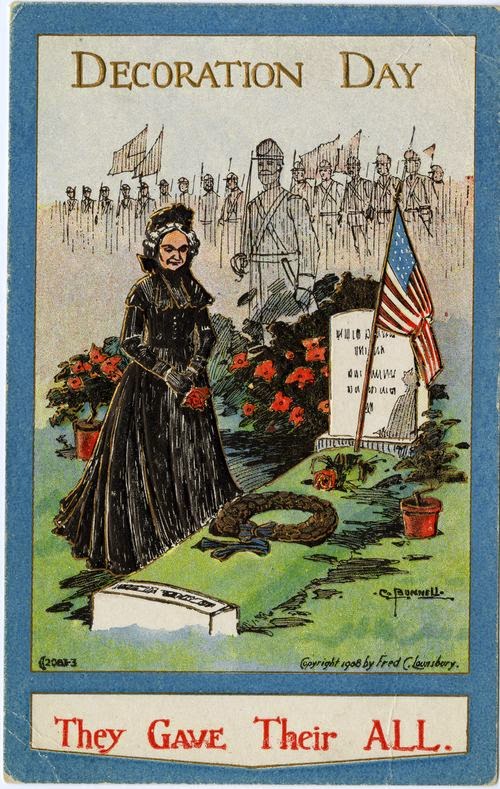
Decoration Day is officially proclaimed May 30th 1868, it would become known as Memorial Day.
On May 5th 1868 General John Logan the national commander of the Grand Army of the Republic issued General Order #11 to proclaim May 30th as a day of memorial. He ordered that flowers should be placed on the graves of Union and Confederate dead at Arlington National Cemetery. It is sure that many were decorating the graves of the dead before this, including Southern women who made placing flowers a practice during the war. New York was the first state to recognize the holiday in 1873. All of the Northern states had adopted the holiday by 1890. It wasn’t until after the First World War that the south joined, choosing instead to honor her dead on different days.
Now most states celebrate Memorial Day on the last Monday in May, ensuring a three day weekend. Several of the southern states still have an additional day to honor the Confederate dead.
On May 5th 1868 General John Logan the national commander of the Grand Army of the Republic issued General Order #11 to proclaim May 30th as a day of memorial. He ordered that flowers should be placed on the graves of Union and Confederate dead at Arlington National Cemetery. It is sure that many were decorating the graves of the dead before this, including Southern women who made placing flowers a practice during the war. New York was the first state to recognize the holiday in 1873. All of the Northern states had adopted the holiday by 1890. It wasn’t until after the First World War that the south joined, choosing instead to honor her dead on different days.
Now most states celebrate Memorial Day on the last Monday in May, ensuring a three day weekend. Several of the southern states still have an additional day to honor the Confederate dead.
Wednesday, May 13, 2009
First Burial
Arlington National Cemetery accepted her first solider on May 13th 1864, the Pennsylvania Private William Henry Christman.The Arlington National Cemetery in Arlington, Virginia is a military cemetery established on the estate of Robert E Lee’s wife, Mary Anna [Custis] Lee, known as Arlington House. She was the descendant of the first First Lady Martha Washington. When Lee joined the Confederate Army, Union troops occupied the home and forced Mary Lee off her property. The cemetery is right across the Potomac River from Washington DC.
William Henry Christman was born 1843. He was a labored from Lehigh County Pennsylvania, and enlisted in the Union Army March 25th 1864 as a member of the 67th PA Infantry. He came down with measles three weeks latter, and was admitted to the hospital. He died May 11th 1864 and became the first soldier to be buried in Arlington Cemetery on May 13th 1864.
The early burials were made in Mary Lee’s rose garden. These first graves were dug by a former Arlington House slave, James Parker. He would latter become the only person buried in the Arlington National Cemetery who was born on the property. There would be 2,111 unknown Civil War dead buried just outside of Arlington House in 1866, with a memorial built on the grounds to honor these Union soldiers.
Subscribe to:
Posts (Atom)