Showing posts with label Abraham Lincoln. Show all posts

Sunday, January 3, 2016

Not To Secede

Two weeks after the first southern state; South Carolina seceded, Delaware’s legislature voted on 3 January 1861 not to secede from the Union.

Slavery was a troublesome issue in Delaware, where the influence of Quakerism led many slaveholders to free their slaves.  By 1860 over 90% of the state’s black population were freedmen.

Following South Carolina’s section, Delaware’s legislature voted on 3 January 1861, not to secede and to stay in the Union.  One of the five border, slave holding states to remain in the Union [Kentucky, Maryland, Missouri, and when it became a state; West Virginia].  Governor William Burton said that Delaware was the first state to ratify the Constitution, and join the Union, and it would be the last to leave it.


Although Delaware stayed in the Union, there were deep sympathies among the population for both sides.  Union troops had to occupy polling stations in the state in 1862 while state and federal elections were being held, due to fears of political intimidation.  Lincoln lost both of his presidential elections in Delaware.  It was the only slave holding state in which no Confederate regiments or militia was raised.  About 13,000 men fought for the Union, including 954 black troops.  There were an estimated few thousand men who left the state and enlisted in Confederate service in neighboring states.

Saturday, May 31, 2014

He Changed His Position

Confederate Colonel Robert Hopkins Hatton was killed May 31st 1862 at the Battle of Fair Oaks [also called the Battle of Seven Pines].

Robert Hopkins Hatton was born November 2nd 1826 in Steubenville, Ohio.  While still a child his family moved to Tennessee.  He would receive a degree from the Cumberland University, pass the bar and begin a law practice in Lebanon, Tennessee in 1850.  He became a member of the Whig Party and won a seat in the Tennessee State Legislature in 1855 and to the United States Congress in 1858.  While in Congress Hatton was the chairman of the Committee on Expenditures in the Department of the Navy.

Hatton wished to see the Union preserved and opposed secession, but after President Abraham Lincoln made his call for troops Hatton changed his position.  He raised the Lebanon Blues, which became a part of the 7th Tennessee Infantry, and was elected the Colonel of the Regiment.  In 1862 Hatton and the 7th were part of the troops protecting Richmond, Virginia from Union Major General George B McClellan during the Peninsula Campaign.


On May 31st 1862 while leading troops at the Battle of Fair Oaks, Hatton was shot in the head and killed.  His body was sent back to Tennessee, but as Middle Tennessee was held by the Union his body was temporarily placed in Knoxville.  He would be reentered in 1866 in the Cedar Grove Cemetery in Lebanon, Tennessee.

Monday, April 28, 2014

Maine's Three Month Men

The 1st Maine Infantry answered President Abraham Lincoln’s call for volunteers, completing the raising of their regiment on April 28th 1861.

When President Abraham Lincoln made his first call for troops in April 1861, the State of Maine was required to raise one infantry regiment for three months of military service.   In Maine the one regiment of infantry was raise by reorganizing 10 state militia companies and was completed on April 28th 1861 at Portland, Maine.  The 779 men were mustered into the three month regiment on May 3rd 1861 under the command of Colonel Nathaniel Jackson as the 1st Maine Infantry.


The First Maine was shipped to Washington, DC where they served from June 1st 1861 until August 1st 1861.  The men spent their whole service with the 1st camped at Meridian Hill, defending Washington, DC.  When the 1st was mustered out of service on August 5th 1861, many of the men found they had signed enlistment papers for two or three years of service.  Eight companies of these men were transferred to the 10th Maine Infantry.

Saturday, April 26, 2014

Useless Useless

On April 26th 1865, Union soldiers caught up with John Wilkes Booth at the Garrett Farm, and killed him.

Union Lieutenant Colonel Everton Conger learned through interrogation that John Wilkes Booth and David E Herold were at the Richard Garrett Farm near Port Royal, Virginia.  In the early morning hours of April 26th 1865 Conger accompanied 25 Union soldiers from the 16th New York Cavalry commanded by Lieutenant Edward P Doherty. They surrounded the tobacco barn that Booth and Herold were hiding in, and demanded their surrender.  Herold gave himself up, but Booth refused, so the soldiers set the barn on fire.

Booth could be seen moving around inside the burning barn.  Union Sergeant Boston Corbett, claimed to have seen Booth raise a gun to shot, and so he fired at Booth. The shot struck Booth in the neck.  He was dragged from the barn and placed on the porch of the Garrett farmhouse.  The bullet had gone through several vertebrae and partially severed his spinal cord.  As he got close to dying, Booth said, "Tell my mother I died for my country."  He then asked that his hands be held up where he could see them and said his last words, "Useless, useless."  It took him three hours to die.

In Booth’s pockets were the pictures of five different women, a candle, a compass, and his diary.  In the diary Booth had written of President Abraham Lincoln, "Our country owed all her troubles to him, and God simply made me the instrument of his punishment."


To read some eyewitness accounts of The Death of John Wilkes Booth check this web site.

Thursday, April 3, 2014

Bitter Bitter Tears

The Confederate capital of Richmond, Virginia fell to Union control April 3rd 1865.

Union General Ulysses S Grant had been working toward a takeover of the Confederate capital of Richmond, Virginia for nearly ten months.  On April 1st 1865 Grant crushed Confederate Robert E Lee’s line at Five Forks, and Grant kept up the pressure the next day all along the Confederate’s Petersburg line.  Lee’s line collapsed.  That same night the Confederate government in Richmond evacuated the city leaving on the last open railroad line, with the army leaving right behind them.  As the Confederate soldiers left, they set fire to the armory, bridges and warehouse, a fire that burned out of control and spread through the city.

On the morning of April 3rd 1865 the mayor and some other elite citizens surrendered Richmond, and Union troops entered the capital city.  The Union soldiers fought and put out the fires, but not before it burned about 10% of the city.  Mary Fontaine a resident of Richmond, Virginia wrote that she "saw them unfurl a tiny flag, and I sank on my knees, and the bitter, bitter tears came in a torrent."  Among the first Union troops to enter the city were the black troops of the 5th Massachusetts Cavalry, many of the city’s residents considered this proof that their world was over.


President Abraham Lincoln toured the city just a few days later with his son Tad.

Sunday, March 30, 2014

An Engineer And Soldier

John Newton received his appointment to Union Major General March 30th 1863.

John Newton was born August 25th 1822 in Norfolk, Virginia the son of United States Congressman Thomas and Margaret (Jordan) Newton Jr.  He attended the United States Military Academy at West Point, graduating second in the class of 1842.  He was commissioned in the Corps of Engineers and taught the subject from 1843 to 1846 at the Academy.  After which Newton served in engineering work along the Atlantic coast, the Great Lakes, and the Gulf Coast.

When the Civil War began, Newton stayed loyal to the Union.  He helped with the construction of the defenses of Washington, DC.  He was leading a brigade during the Peninsula and Maryland Campaigns, and fought at the Battle of Antietam.  Newton had become a division commander in the VI Corps by the Battle of Fredericksburg.  He was among the officers who traveled to Washington, DC to complained to United States President Abraham Lincoln of their lack of confidence in their commander; Union Major General Ambrose E Burnside.  On March 30th 1863 Newton was appointed Major General.  He was wounded during the Chancellorsville Campaign at Salem Church.  During the Battle of Gettysburg Newton took command of the I Corps of the Army of the Potomac after the death of Union Major General John F Reynolds, and would continue in that position until the army was reorganized in 1864.  He was then placed in commanded of a division in the IV Corps during the Atlanta Campaign.  After this he was moved to command of the District of Key West, with his last campaign of the war a defeat at the Battle of Natural Bridge in Florida in March 1865.


After the war Newton returned to the Corps of Engineers.  He would oversee the improvements of the waters around New York City, and the Hudson River south of Albany, New York.  He was appointed Chief of Engineers in 1884.  On October 10th 1885 Newton used 140 tons of dynamite and blew up New York’s Hell Gate Rock.  He retired from the Army in 1886, serving as a Commissioner of Public Works in New York City, and as President of the Panama Railroad Company.  Newton died May 1st 1895 in New York City, New York, and is buried in the cemetery at West Point.

Friday, March 28, 2014

The Four Important Men

United States President Abraham Lincoln travel to City Point, Virginia and on March 28th 1865 [I have seen the date listed as March 27th] met with his Generals about the wrap up of the Civil War.

Union General William T Sherman’s troops were moving north up through the Carolinas, and Ulysses S Grant was about the break the 10 month long siege on Petersburg, Virginia that had been holding Confederate General Robert E Lee in place.  Lincoln had come to Virginia to meet with these men; he also toured the Union line in front of Petersburg, reviewed the troops and visited with the wounded.


On March 28th 1865 Lincoln, Grant, Sherman and Union Admiral David Dixon Porter sat down together on the USS River Queen.  This was the first time Lincoln and Sherman had ever met.  Lincoln explained his worries that Lee could break out of Petersburg, move his troops south, join up with Confederate General Joseph E Johnston’s Army in North Carolina, and the war would go on for many more months.  He was assured by Grant and Sherman that the end of the war was close, although Grant wrote after the war that he “was afraid every morning that I would wake from my sleep to hear that Lee had gone, and that nothing was left but his picket line.”  Lincoln then stressed that the Confederates’ surrender term had to preserve the Union, and uphold the emancipation.  He told the men that he wanted the “Confederate armies back to their homes, at work on their farms and in their shops. Let them have their horses to plow with, and, if you like, their guns to shoot crows with. I want no one punished; treat them liberally all round. We want those people to return to their allegiance to the Union and submit to the laws.”

Monday, March 17, 2014

The Youngest Raider

Union Private Jacob Wilson Parrott, a member of Andrews’ Raiders, was exchanged along with other members of the Raiders on March 17th 1863 for Confederate soldiers at Camp Point, Virginia.

Jacob Wilson Parrott was born July 17th 1843 in Fairfield County, Ohio, the son of George and Anna (Landfair) Parrett Jr.

At the beginning of the Civil War, Parrott joined the 90 day 20th Ohio Infantry.  When the term of service was up he went home to Kenton, Ohio where he enlisted in Company K of the 33rd Ohio Infantry.  His first combat was November 8th 1861 during the Battle of Ivy Mountain.

In April 1862 when James J Andrews was looking for volunteers to take part in his raid, Parrott joined with 21 other men, becoming known as Andrews’ Raiders.  The Raiders slipped 200 miles south behind Confederate lines and hijacked the train “The General”.  Parrott was among the men who were captured during the raid.  While being held as a prisoner he was beaten numerous times in an attempt to get him to talk.  Parrott even escaped once with fourteen others, but was recaptured.  He was part of a prisoner exchanged March 17th 1863.

After the exchange Parrott was taken to Washington, DC where he met with President Abraham Lincoln.  Parrott, the youngest surviving member of Andrews’ Raiders, was the first man to receive the Medal of Honor.  He would serve out the rest of the war ending as a First Lieutenant.

When the war ended Parrott returned to his home in Ohio.  He ran a stone quarry and worked as a cabinet maker.  While walking home on December 22nd 1908, he had a heart attack and died.  Parrott is buried in the Grove Cemetery in Kenton, Ohio.


Parrott’s Medal of Honor citation reads: One of the 19 of 22 men (including 2 civilians) who, by direction of Gen. Mitchell (or Buell) penetrated nearly 200 miles south into enemy territory and captured a railroad train at Big Shanty, Ga., in an attempt to destroy the bridges and tracks between Chattanooga and Atlanta.

Wednesday, February 12, 2014

A Black Minister For The Union

Henry Highland Garnet was the first African American to preach to the United States House of Representatives, he did so on February 12th 1865.

Henry Highland Garnet was born a slave December 23rd 1815 in New Market, Kent, Maryland, the son George and Henrietta Garnet.  When he was 10 Garnet’s family fled with the help of the Underground Railroad to New York City.  He attended the African Free School, and the Phoenix High School for Colored Youth.  In 1835 Garnet received a placement at the Noyes Academy in Canaan, New Hampshire.  Anger over his abolitionist activities cause him to leave New Hampshire, he finished his education at the Oneida Theological Institute in Whitesboro, New York.

Garnet moved to Troy, New York in 1839, where he taught school.  In 1842 he became the pastor of the Liberty Street Presbyterian Church.  It was here that Garnet began publishing papers with abolitionist, religious, and temperance themes.  On returning to New York City he joined the American Anti-Slavery Society and was a frequent speaker.  He felt that slaves should act for their own freedom, advocating for armed rebellion, and was a supporter of blacks emigrating so they would have more opportunities, or at the least Black Nationalism in the United States with their own colony in the states.  Garnet traveled in the 1850’s to England, and Jamaica as a lectures and missionary.

When the Civil War started Garnet gave up on the hopes of emigration for black.  He began working for the founding of black Union army units.  Garnet and his family barely escaped the July 1863 New York City Draft Riots.  He moved his family shortly after this to Washington, DC, where he helped with the recruiting of black units.  It was during this time that Garnet became the first black minister on February 12th 1865 to preach to the United States House of Representatives.  His service was arranged by President Abraham Lincoln and his Cabinet as a special service for the Presidents 56th birthday.


After the war ended Garnet became the president of the Avery College in Pittsburgh, Pennsylvania.  He would return later to the ministry, becoming the pastor of the Shiloh Presbyterian Church in New York City.  He was appointed by President James A Garfield in 1881 as the United States Minister to Liberia, and he would die there just a few months into his service on February 13th 1882.  Garnet was honored by the Liberian government with a state funeral, and is buried in the Palm Grove Cemetery in Monrovia.

Tuesday, February 11, 2014

Providing Information

One of the first orders that Union Major General Joseph Hooker made after becoming the commander of the Army of the Potomac was on February 11th 1863, creating the Bureau of Military Information.

The Pinkerton National Detective Agency, run by Allan Pinkerton assumed responsibility for President Abraham Lincoln’s safety in 1861.  Pinkerton also provided intelligence for Union General George B McClellan.  General Winfield Scott hired Lafayette C Baker a detective for information.  Lincoln himself paid a publisher; William A Lloyd to infiltrate the Confederacy and provide information.  In all these cases though, these men were civilians.

When Union Major General Joseph Hooker became the commander of the Army of the Potomac, he ordered his deputy provost marshal Colonel George H Sharpe to create an intelligence unit.  Sharpe received assistance from John C Babcock; a former Pinkerton employee and they established the Bureau of Military Information [the BMI] on February 11th 1863.

The BMI had about 70 field agents during the, 10 of whom were killed during the war.  These and additional agents preformed interrogations, scanned confederate newspapers and captured documents for information that could be helpful to the Union war effort.  Union General Ulysses S Grant kept BMI staff in his headquarters, so he would have the most recent information.


The BMI ceased to be once the Civil War came to an end in 1865. 

Saturday, February 1, 2014

Number Seven

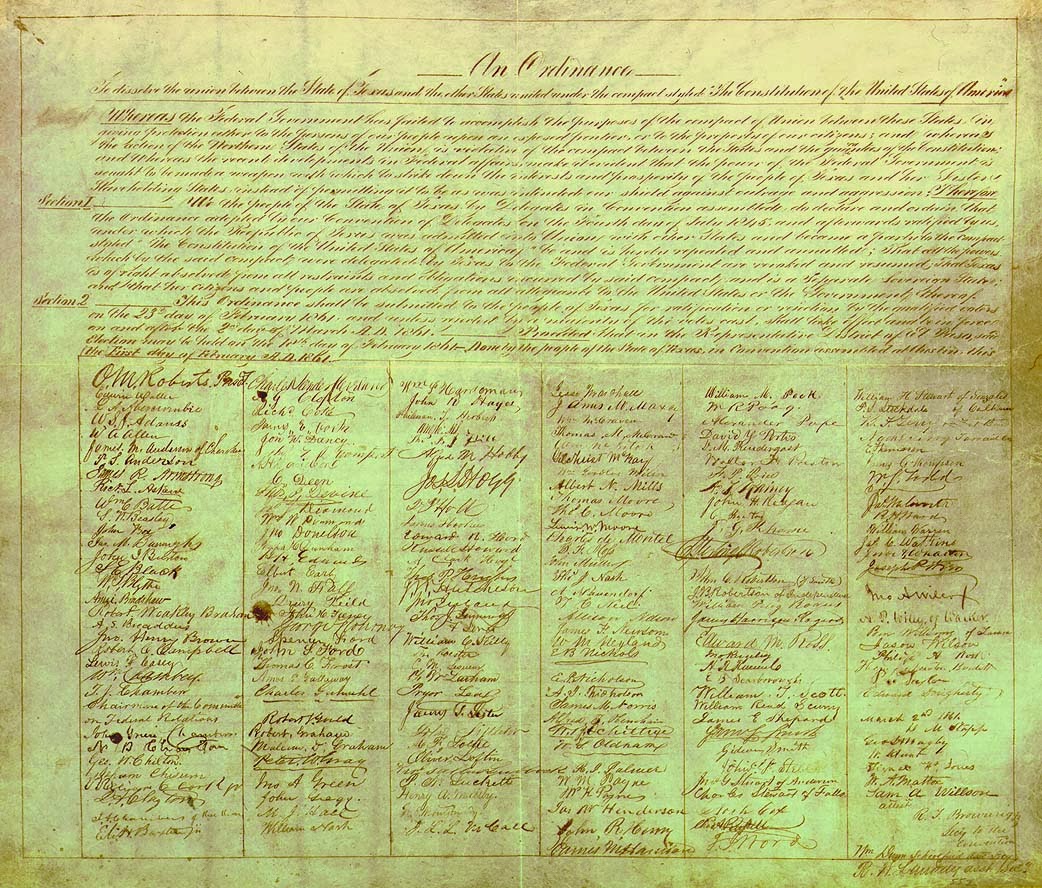
Texas joined six other states on February 1st 1861 and seceded from the Union.

Samuel Houston the Governor of Texas was a faithful Unionist, and his election in 1859 made it seem that Texas would stay in the Union, but the people of Texas felt differently.  Following Abraham Lincoln’s election to President there was pressure placed on Houston to call for a convention to consider secession.  Houston grudgingly called for a convention in January 1861.  He sat silently on February 1st 1861 when the convention voted in favor of seceding.  The vote was 166 to 8 in favor, making Texas the seventh state to leave the Union.

In the end 76% of Texans voted in a statewide referendum to secede.  Texas became a Confederate States on March 2nd 1861.  Houston who refused to take an oath of allegiance to the Confederacy was replaced as Governor by his Lieutenant Governor.


If you like to read the Texas Ordinance of Secession you can find it here.

Tuesday, January 28, 2014

The President's Valet

African American William Henry Johnson a personal valet of United States President Abraham Lincoln died January 28th 1864 most likely from smallpox.

William Henry Johnson a free African American was born about 1835.  He was working in Springfield, Illinois as a barber and bootblack when he met Abraham Lincoln in 1860.  When Lincoln became President he brought Johnson with him to the White House.  There seems to have been issues between the existing White House staff and Johnson.  In a letter that Lincoln wrote to United States Navy Secretary Gideon Welles on March 7th 1861 he stated the trouble seemed to be “the difference of color between him and other servants is the cause of our separation.”  Lincoln found other employment for Johnson as a messenger for the United States Treasury Department.  Johnson however continued to work mornings as the President’s valet and barber.

On November 18th 1863 Johnson traveled by train with Lincoln to Gettysburg, Pennsylvania for the dedication of the Soldier’s National Cemetery.  The President contracted smallpox and while tending to Lincoln, Johnson also came down with disease.  The President recovered, but Johnson died on January 28th 1864 in Washington, DC.

Lincoln paid for Johnson’s funeral.  Interestingly it is unknown to a certainty where Johnson is buried.  There are two places that claim his remains, Arlington National Cemetery, and the Columbian Harmony Cemetery.


Recommended reading on this subject can be found at Mr. Lincoln and Mr. Johnson

Sunday, January 26, 2014

I Think He Is Harder On Me

United States President Abraham Lincoln wrote a letter on January 26th 1863 to Union General Joseph Hooker upon his ascending to command of the Army of the Potomac.

Union General Joseph Hooker was the fourth in a line of commanding General of the Army of the Potomac, a part of President Abraham Lincoln’s search for a general who would give him a victory.  When Hooker was given command, Lincoln placed a letter in his hand stating Hooker’s good and bad qualities it commended his bravery, military skill, and confidence, as well as the fact that the President knew Hooker had undercut Union General Ambrose E Burnside.  Hooker told Noah Brooks; a reporter, that it was the kind of “letter as a father might write to his son. It is a beautiful letter, and, although I think he was harder on me than I deserved, I will say that I love the man who wrote it."

It was only five months later that Lincoln replace Hooker with Union General George G Meade right before the Battle of Gettysburg.

The letter written January 26, 1863 follows as:
Major General Hooker:
General.

I have placed you at the head of the Army of the Potomac. Of course I have done this upon what appear to me to be sufficient reasons. And yet I think it best for you to know that there are some things in regard to which, I am not quite satisfied with you. I believe you to be a brave and a skilful soldier, which, of course, I like. I also believe you do not mix politics with your profession, in which you are right. You have confidence in yourself, which is a valuable, if not an indispensable quality. You are ambitious, which, within reasonable bounds, does good rather than harm. But I think that during Gen. Burnside's command of the Army, you have taken counsel of your ambition, and thwarted him as much as you could, in which you did a great wrong to the country, and to a most meritorious and honorable brother officer. I have heard, in such way as to believe it, of your recently saying that both the Army and the Government needed a Dictator. Of course it was not for this, but in spite of it, that I have given you the command. Only those generals, who gain successes, can set up dictators. What I now ask of you is military success, and I will risk the dictatorship. The government will support you to the utmost of its ability, which is neither more nor less than it has done and will do for all commanders. I much fear that the spirit which you have aided to infuse into the Army, of criticizing their Commander, and withholding confidence from him, will now turn upon you. I shall assist you as far as I can, to put it down. Neither you, nor Napoleon, if he were alive again, could get any good out of an army, while such a spirit prevails in it.


And now, beware of rashness. Beware of rashness, but with energy, and sleepless vigilance, go forward, and give us victories.

Sunday, January 12, 2014

A Lincoln Supporter

Smith Dykins Atkins was nominated by President Abraham Lincoln to be promoted to Brevet Brigadier General January 12th 1865.

Smith Dykins Atkins was born June 9th 1836 in Horseheads, New York the son of Adna S and Sarah (Dykins) Atkins.  His family moved to Illinois in 1845 where he attended the Rock River Seminary in Mount Morris, Illinois.  He had a law practice and was the editor of the Mount Morris Gazette.  He worked for Abraham Lincoln’s election in 1860.

At the call for Union troops following the firing on Fort Sumter, Atkins became the first man from Stephenson County, Illinois to enlist.  He was appointed Captain of the 11th Illinois Infantry April 30th 1861, and then Major in early 1862.  Due to illness he resigned in April 1862, but was back in service by September 1862 as the Colonel of the 92nd Illinois Mounted Infantry.  In February 1863 Atkins was commanding a brigade in the Union Army of Kentucky.  He led a brigade of cavalry during the March to the Sea.  President Abraham Lincoln nominated Atkins to receive the promotion grade of Brevet Brigadier General January 12th 1865, which was confirmed by the United States Senate in February of that year.


Following the war Atkins returned to Illinois, but not before meeting and marrying Ella Swain the daughter of David Swain who was the president of the University of North Carolina.  Atkins became the editor of the Freeport, Illinois newspaper and the city’s postmaster.  He wrote two books, and served as the first president of the Freeport Public Library.  Atkins died March 27th 1913 in Freeport, Illinois and is buried in the Freeport City Cemetery. 

Tuesday, December 17, 2013

Voted Unanimously

The only South Carolina convention to vote unanimously for secession was held December 17th 1860 at the First Baptist Church of Columbia, South Carolina.

The First Baptist Church of Columbia, South Carolina was organized in 1809, with a building on Sumter Street.  The current church was built in 1856 with funding from the former president of the Southern Baptist Theological Seminary; James P Boyce.

In 1860, following the election of Abraham Lincoln as President of the United States, the Church became the site of the first South Carolina state convention to discuss secession.  The meeting was called to order by chairman D F Jamison with delegates who had been selected a month early.  They left with a unanimous vote of 159 to 0 in favor of South Carolina seceding from the Union on December 17th 1860.


The convention at the Church in Columbia lasted only one day do to an outbreak of smallpox.  The South Carolina Order of Secession wasn’t signed until delegates reconvened in Charleston, South Carolina on December 20th 1860.

Sunday, December 8, 2013

Amnesty and Reconstruction

President Abraham Lincoln submitted his Proclamation of Amnesty and Reconstruction on December 8th 1863.

As the Civil War’s third year was coming to an end, President Abraham Lincoln began making plans for a postwar reconstruction of the United States.  Large parts of the south formally held by the Confederacy had been captured by the Union army and some of those States were beginning to rebuild their governments.  Lincoln’s Proclamation of Amnesty covered three main areas for reconstruction for the southern states.  First it gave a pardon to all but the highest Confederate government officials and military men with ranks under Colonel, with a restoration of all properties; not including slaves.  Next it said that any state could set up a new government when 10% of the eligible voters had taken an oath of allegiance to the United States.  And lastly, the states to be readmitted, needed to set a plan to deal with freed slaves that would not impede their freedom.

The Proclamation of Amnesty read, “WHEREAS, in and by the Constitution of the United States, it is provided that the President “shall have power to grant reprieves and pardons for offences against the United States, except in cases of impeachment;” and

Whereas, a rebellion now exists whereby the loyal state governments of several states have for a long time been subverted, and many persons have committed, and are now guilty of, treason against the United States; and

Whereas, with reference to said rebellion and treason, laws have been enacted by congress, declaring forfeitures and confiscation of property and liberation of slaves, all upon terms and conditions therein stated, and also declaring that the President was thereby authorized at any time thereafter, by proclamation, to extend to persons who may have participated in the existing rebellion, in any state or part thereof, pardon and amnesty, with such exceptions and at such times and on such conditions as he may deem expedient for the public welfare; and

Whereas, the congressional declaration for limited and conditional pardon accords with well-established judicial exposition of the pardoning power; and

Whereas, with reference to said rebellion, the President of the United States has issued several proclamations, with provisions in regard to the liberation of slaves; and

Whereas, it is now desired by some persons heretofore engaged in said rebellion to resume their allegiance to the United States, and to re-inaugurate loyal state governments within and for their respective states: Therefore–

I, ABRAHAM LINCOLN, President of the United States, do proclaim, declare, and make known to all persons who have, directly or by implication, participated in the existing rebellion, except as hereinafter excepted, that a full pardon is hereby granted to them and each of them, with restoration of all rights of property, except as to slaves, and in property cases where rights of third parties shall have intervened, and upon the condition that every such person shall take and subscribe an oath, and thenceforward keep and maintain said oath inviolate; and which oath shall be registered for permanent preservation, and shall be of the tenor and effect following, to wit:–

“I,                  , do solemnly swear, in presence of Almighty God, that I will henceforth faithfully support, protect, and defend the Constitution of the United States and the Union of the States thereunder; and that I will, in like manner, abide by and faithfully support all acts of congress passed during the existing rebellion with reference to slaves, so long and so far as not repealed, modified, or held void by congress, or by decision of the supreme court; and that I will, in like manner, abide by and faithfully support all proclamations of the President made during the existing rebellion having reference to slaves, so long and so far as not modified or declared void by decision of the supreme court. So help me God.”

The persons excepted from the benefits of the foregoing provisions are all who are, or shall have been, civil or diplomatic officers or agents of the so-called Confederate government; all who have left judicial stations under the United States to aid the rebellion; all who are, or shall have been, military or naval officers of said so-called Confederate government above the rank of colonel in the army or of lieutenant in the navy; all who left seats in the United States congress to aid the rebellion; all who resigned commissions in the army or navy of the United States and afterwards aided the rebellion; and all who have engaged in any way in treating colored persons, or white persons in charge of such, otherwise than lawfully as prisoners of war, and which persons may have been found in the United States service as soldiers, seamen, or in any other capacity.
And I do further proclaim, declare, and make known that whenever, in any of the States of Arkansas, Texas, Louisiana, Mississippi, Tennessee, Alabama, Georgia, Florida, South Carolina, and North Carolina, a number of persons, not less than one tenth in number of the votes cast in such state at the presidential election of the year of our Lord one thousand eight hundred and sixty, each having taken the oath aforesaid, and not having since violated it, and being a qualified voter by the election law of the state existing immediately before the so-called act of secession, and excluding all others, shall reestablish a state government which shall be republican, and in nowise contravening said oath, such shall be recognized as the true government of the state, and the state shall receive thereunder the benefits of the constitutional provision which declares that “the United States shall guaranty to every state in this Union a republican form of government, and shall protect each of them against invasion; and on application of the legislature, or the executive, (when the legislature cannot be convened,) against domestic violence.”

And I do further proclaim, declare, and make known that any provision which may be adopted by such state government in relation to the freed people of such state, which shall recognize and declare their permanent freedom, provide for their education, and which may yet be consistent as a temporary arrangement with their present condition as a laboring, landless, and homeless class, will not be objected to by the National Executive.

And it is suggested as not improper that, in constructing a loyal state government in any state, the name of the state, the boundary, the subdivisions, the constitution, and the general code of laws, as before the rebellion, be maintained, subject only to the modifications made necessary by the conditions hereinbefore stated, and such others, if any, not contravening said conditions, and which may be deemed expedient by those framing the new state government.

To avoid misunderstanding, it may be proper to say that this proclamation, so far as it relates to state governments, has no reference to states wherein loyal state governments have all the while been maintained. And, for the same reason, it may be proper to further say, that whether members sent to congress from any state shall be admitted to seats constitutionally rests exclusively with the respective houses, and not to any extent with the Executive. And still further, that this proclamation is intended to present the people of the states wherein the national authority has been suspended, and loyal state governments have been subverted, a mode in and by which the national authority and loyal state governments may be reestablished within said states, or in any of them; and while the mode presented is the best the Executive can suggest, with his present impressions, it must not be understood that no other possible mode would be acceptable.


Given under my hand at the city of Washington the eighth day of December, A.D. one thousand eight hundred and sixty-three, and of the Independence of the United States of America the eighty-eighth.”

Tuesday, November 12, 2013

The Belle Of The North

Katherine Jane Chase the daughter of the United States Secretary of the Treasury, married Rhode Island Governor William Sprague November 12th 1863 at the Chase home in Washington, DC.

Katherine Jane Chase; always called Kate, was born August 13th 1840 in Cincinnati, Ohio, the daughter of Salmon P and Eliza Ann (Smith) Chase.  She was sent to school in New York City to the Haines School, where she learned elocution, history, languages, music, and most importantly the social graces.  After being away at school for nine years Chase returned to Columbus, Ohio, a beautiful 18 year old, to serve as hostess for her widowed father, who had been newly elected Governor.  She was a beautiful, intelligent young woman who impressed her father’s many political friends.

Chase came to Washington, DC with her father, when he became President Abraham Lincoln’s Secretary of the Treasury in 1861.  She set up their home in Washington and continued to act as his hostess.  The parties she held were much sought after invitations, and she quickly became the “Belle of the North”.  Chase made a point of visiting the Union camps surrounding Washington, and making friends of Union General.  She was also out spoken on her views of how the war should be fought.

On November 12th 1863 Chase married Rhode Island Governor William Sprague in her father’s home in Washington, DC.  It was the social event of the year.  The United States Marine Corps Band played a march composed by Thomas Mark Clark just for the occasion.  President Lincoln attended the ceremony, but his wife Mary, who didn’t like Chase, did not go.

Hers was not a happy marriage.  Both Chase and her husband apparently had affairs, and the marriage ended in divorce in 1882.  After the divorce she took back her maiden name.  Chase moved with three of her children to her late father’s estate “Edgewood” near Washington, DC.  She died there July 31st 1899 in poverty of Bright’s disease.  She is buried beside her father in the Spring Grove Cemetery in Cincinnati, Ohio.


If you are interested in reading more, check out The Nuptials of Miss Kate Chase and Ex-Gov. Sprague

Friday, November 8, 2013

The Win Of An Incumbent

United States President Abraham Lincoln was voted into a second term on November 8th 1864, by around 400,000 votes.

The United State presidential election was held Tuesday November 8th 1864, despite the ongoing Civil War.  Sitting President Abraham Lincoln was the Republican or “National Union Party” candidate, running against Democratic “Peace Candidate” Union General George B McClellan.  When the votes were counted, Lincoln won the popular vote by more than 400,000 votes.  Many of these coming from soldiers in the field, and on the strength of the Union win in the Battle of Atlanta on September 6th 1864.  It was the first time that soldiers in the field were allowed to cast ballots, and around 70% went for Lincoln.  From the stand point of the Electoral College Lincoln took 212 of the 233 available votes.


Lincoln was the first incumbent president to win a reelection since Andrew Jackson was reelected to a second term in 1832.

Monday, October 14, 2013

From Bangor To Washington


Union President Abraham Lincoln extended the reach of the suspension of the Writ of Habeas Corpus on October 14th 1861.

Near the beginning of the Civil War Union President Abraham Lincoln ordered a suspension of the Writ of Habeas Corpus in Maryland and parts of the Midwestern states.  This was in response to the arrest by Union troops in Maryland of secessionist John Merryman, whom Supreme Court Chief Justice Roger B Taney ordered released under a writ of habeas corpus.  Lincoln and the military ignored the ruling.

On October 14th 1861 Lincoln expanded the suspension with this written order:

LIEUTENANT-GENERAL WINFIELD SCOTT:

The military line of the United States for the suppression of the insurrection may be extended so far as Bangor, in Maine. You and any officer acting under your authority are hereby authorized to suspend the writ of habeas corpus in any place between that place and the city of Washington.

ABRAHAM LINCOLN.

By the President:

WILLIAM H. SEWARD, Secretary of State.

Tuesday, August 6, 2013

Any Property That Supports The War Effort

The Confiscation Act of 1861 was signed into law August 6th 1861 by President Abraham Lincoln and included taking slaves.

The bill for the Confiscation Act of 1861 passed both houses of Congress by a wide majority, but Lincoln was hesitant to sign.  With recent Confederate victories he felt the Act would look reckless, and that it could be seen as unconstitutional.  He was lobbied by several Senators who explained that the Act was necessary to take any property; including slaves, that could be used to support the Confederacy’s war efforts.  He signed the Act into law August 6th 1861.

 “An Act to confiscate Property used for Insurrectionary Purposes.

It has been enacted by the Senate and House of Representatives of the United States of America in Congress assembled, That if, during the present or any future insurrection against the Government of the United States, after the President of the United States shall have declared, by proclamation, that the laws of the United States are opposed, and the execution thereof obstructed, by combinations too powerful to be suppressed by the ordinary course of judicial proceedings, or by the power vested in the marshals by law, any person or persons, his, her, or their agent, attorney, or employé, shall purchase or acquire, sell or give, any property of whatsoever kind or description, with intent to use or employ the same, or suffer the same to be used or employed, in aiding, abetting, or promoting such insurrection or resistance to the laws, or any person or persons engaged therein; or if any person or persons, being the owner or owners of any such property, shall knowingly use or employ, or consent to the use or employment of the same as aforesaid, all such property is hereby declared to be lawful subject of prize and capture wherever found; and it shall be the duty of the President of the United States to cause the same to be seized, confiscated, and condemned.

SEC. 2. And be it further enacted, That such prizes and capture shall be condemned in the district or circuit court of the United States having jurisdiction of the amount, or in admiralty in any district in which the same may be seized, or into which they may be taken and proceedings first instituted.

SEC. 3. And be it further enacted, That the Attorney-General, or any district attorney of the United States in which said property may at the time be, may institute the proceedings of condemnation, and in such case they shall be wholly for the benefit of the United States; or any person may file an information with such attorney, in which case the proceedings shall be for the use of such informer and the United States in equal parts.

SEC. 4. And be it further enacted, That whenever hereafter, during the present insurrection against the Government of the United States, any person claimed to be held to labor or service under the law of any State, shall be required or permitted by the person to whom such labor or service is claimed to be due, or by the lawful agent of such person, to take up arms against the United States, or shall be required or permitted by the person to whom such labor or service is claimed to be due, or his lawful agent, to work or to be employed in or upon any fort, navy yard, dock, armory, ship, entrenchment, or in any military or naval service whatsoever, against the Government and lawful authority of the United States, then, and in every such case, the person to whom such labor or service is claimed to be due shall forfeit his claim to such labor, any law of the State or of the United States to the contrary notwithstanding. And whenever thereafter the person claiming such labor or service shall seek to enforce his claim, it shall be a full and sufficient answer to such claim that the person whose service or labor is claimed had been employed in hostile service against the Government of the United States, contrary to the provisions of this act.”