Showing posts with label Winfield Scott Hancock. Show all posts

Sunday, August 25, 2013

We Can Beat Them Yet

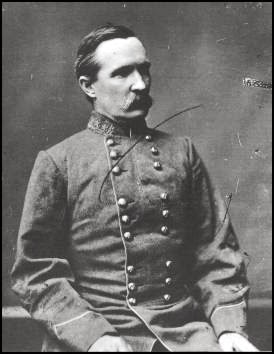
Confederate General Henry Heth
The Second Battle of Ream’s Station was fought August 25th 1864 in Dinwiddie County, Virginia, a part of the Petersburg Campaign.

As the siege of Petersburg began to take hold, Union Lieutenant General Ulysses S Grant began to look for ways to break the railroad lines, and prevent supplies from reaching Confederate General Robert E Lee’s Confederates.  Grant wanted the Petersburg and Weldon Railroad, which ran into Wilmington, North Carolina, stopped and had sent Major General Winfield Scott Hancock’s II Corps in June and Major General Gouverneur K Warren’s V Corps against the railroad in early August.

On August 22nd 1864 Grant again sent out the II Corps along with a cavalry division under Brigadier General David M Gregg.  Gregg’s men drove off some Confederate pickets, and one of the II Corps division commanders, Brigadier General Nelson A Miles’ men destroyed the track to within 2 miles of Reams Station.  Early the next morning August 23rd 1864 another II Corps commanded Brigadier General John Gibbon took up position in some old earthworks located at Reams Station.  Lee couldn’t afford to lose the railroad supply line, and also Ream’s Station was the county seat and should they need it, a potential retreat route.  He sent in Confederate Lieutenant General A P Hill’s Corps which was being led at the time by General Henry Heth, along with two divisions of Major General Wade Hampton’s cavalry to drive them out.

On August 25th 1864 Union troops left their earthworks to destroy the last 5 miles of tracks.  Hancock had them recalled when Confederate cavalry approached.   Hill’s column had advanced down the Dinwiddie Stage Road, and at about 2 pm three infantry brigades led by Brigadier General Cadmus Wilcox launched an attack, but were driven back.  At about the same time some of Hampton’s cavalry had swept around the Union line, but were blocked by Gibbon’s division.  More of Hill’s Corps were brought up, and Confederate Colonel William Pregram’s artillery began firing on the Union position.  The final attack began around 5:30 pm, with the Confederates breaking through the northwest part of the Union fortifications.  Two Union regiments panicked and ran and the Confederates charged the earthworks.  Hancock galloped along the front of his men trying to rally his men; he said “We can beat them yet. Don't leave me, for God's sake!"  The Confederate cavalry at this point made a dismounted charge against Gibbon’s troops causing them to panic, and giving Hampton room to flank the Union line.  Hancock pulled together a counterattack that allowed the Union side to make a withdrawal back to Petersburg.

Union casualties were high, numbering about 2,750 along with 9 cannon and 12 stands of colors, while the Confederates lost only about 800.

Friday, July 5, 2013

What This Has Cost Me

Confederate General Lewis Addison Armistead died July 5th 1863 from a wound received two days earlier at the Battle of Gettysburg during Pickett’s Charge.

Lewis Addison Armistead was born February 18th 1817 in New Bern, North Carolina the son of Walker Keith and Elizabeth (Stanly) Armistead.  He received an appointment to the United States Military Academy at West Point in 1834, but had to leave the school after busting a plate over the head of fellow cadet Jubal Early.  With the help of his father, Armistead obtained a commission to Second Lieutenant in the 6th United States Infantry on July 10th 1839.  He made First Lieutenant on March 30th 1844.  He married his first wife Cecelia Lee Love a cousin of Robert E Lee the same year.  He saw duty in Arkansas and along the Oklahoma border.  Armistead received a Brevet to Captain for actions during the Mexican American War.  Following the war he did duty in Kentucky, and at Fort Dodge.  His first wife died in 1850 and he remarried in 1853.  Armistead continued doing military duty at various post in the west and he lost his second wife as well two children.  He was in command of a garrison in San Diego, California when the Civil War started along with his friend Winfield Scott Hancock.  Armistead resigned his commission and began the trip back to Virginia to join the Confederacy, he told his friend Hancock, "Goodbye; you can never know what this has cost me."

Arriving in Virginia Armistead was made Colonel of the 57th Virginia Infantry.  He was a brigade commander at the Battle of Seven Pines, Malvern Hill and Second Bull Run.  Armistead was the Provost Marshal during the Sharpsburg Campaign.  He was back commanding a brigade at the Battle of Fredericksburg.  As a part of confederate Lieutenant General James Longstreet’s Corps Armistead missed the Battle of Chancellorsville.

Armistead arrived at Gettysburg along with the rest of General George Pickett’s Division on the evening of July 2nd 1863.  The next day Armistead led of his men, in what would become known as Pickett’s Charge.  He crossed the field in front of his Brigade, reaching the stonewall at the “Angle”, getting farther than any other brigade that day.  Crossing the wall, he was shot three times in the arm and below the knee.  Armistead’s wounds weren’t thought to be mortal.  He was taken the hospital on the Spangler Farm for treatment where he died as chief surgeon Doctor Daniel Brinton said, “not from his wounds directly, but from secondary fever and prostration,” on July 5th 1863.  His body was removed to the Old Saint Paul’s Cemetery in Baltimore, Maryland.  General Lee wrote in his after action report, "Brigadier-Generals Armistead, Barksdale, Garnett and Semmes died as they had lived, discharging the highest duties of patriots with devotion that never faltered and courage that shrank from no danger."


Wednesday, August 22, 2012

He Received The Masonic Sign

A member of the 140th Pennsylvania Infantry, Henry Harrison Bingham received his commission on August 22nd 1862 to First Lieutenant.

Henry Harrison Bingham was born December 4th 1841 in Philadelphia, Pennsylvania.  He attended Jefferson College in Canonsburg, Pennsylvania, and would graduate with a law degree from Washington and Jefferson College in Washington, Pennsylvania.

Bingham enlisted in the Union Army, and was commissioned First Lieutenant in the 140th Pennsylvania Infantry August 22nd 1862.  During the Battle of Gettysburg he was part of Union Major General Winfield Scott Hancock’s Second Corps.  He was near the Angle as Pickett’s Charge came to its conclusion.  Bingham would be the man to whom Confederate Brigadier General Lewis Addison Armistead gave the Masonic sign after being wounded. [Although this story has been discounted recently.] Bingham who was a Captain would come to Armistead’s aid, receive his personal effects and tell Hancock the news of his old friend.  During the Battle of Wilderness Bingham was the aide-de-camp to Union Major General Gouverneur Kemble Warren.  As a Captain in Company G of the 140th Pennsylvania on May 6th 1864 he "rallied and led into action a portion of the troops who had given way under fierce assaults of the enemy."  For this action he would be awarded the Medal of Honor.  Bingham was wounded at the Battle of Spotsylvania and captured at the Battle of Fair Oak.

After the war Bingham was appointed by President Andrew Johnson to Postmaster of Philadelphia, a post he held until December 1872.  He was a delegate at the Republican National Conventions from 1872 through 1900.  He was a Congressman from 1879 until his death, serving as the Chairman of several committees.  Bingham died March 22nd 1912 in Pennsylvania and is buried in the Laurel Hill Cemetery in Philadelphia.

Tuesday, July 12, 2011

Served For Almost Four Years

The 5th Wisconsin a Union infantry regiment was formed July 12th 1861 in Madison, Wisconsin.


The 5th Wisconsin Infantry was formed at Camp Randall in Madison, Wisconsin July 12th 1861. The regiment left for Washington, DC July 24th 1861, where they went into camp on Meridian Hill. The 5th was assigned to Winfield Scott Hancock’s Brigade in the Army of the Potomac. This group saw action in many of the battles of eastern theater including Antietam, Fredericksburg, and Gettysburg. In August and September of 1863 they were placed on detached duty in Albany and Tory, New York as part of the surpresion of the draft riots. The 5th was present at Appomattox when Confederate General Robert E Lee surrendered. The unit served until June 24th 1865 and were mustered out of service July 11th 1865.

The 5th mustered in 1108 men, and add another 832 so the regiment totaled 1940 men. During the course of the war they had 17 officers and 332 enlisted who were killed or died from wounds and diseases.

Friday, April 16, 2010

Hamper The Enemy


The Battle of Dam No 1 was fought on April 16th 1862 as part of the larger Peninsula Campaign.


A part of Union Major General George B McClellan’s Peninsula Campaign probed the defensive line at Dam No 1 on the Warwick River in Virginia. General Winfield Scot Hancock had reported a potential weak point there on April 6th 1862. The Confederate had been strengthen their position there and McClellan was concerned they would impede his placing siege batteries. McClellan ordered Brigadier General William F “Baldy” Smith to “hamper the enemy” so that they couldn’t complete their defensive works.

At 8am April 16th 1862 there was an artillery bombardment, after which Brigadier General William T H Brooks sent skirmishers from the Vermont Brigade forward to fire on the Confederates. Ordered to cross the river if it appeared the Confederate forces were withdrawing, at 3pm four companies of the 3rd Vermont Infantry went across the dam. Confederate Colonel Thomas Cobb of the Georgia Legion attacked the Vermonters. It was during this action that drummer Julian A Scott would be awarded the Medal of Honor for making several trips across the creek with wounded while under fire. Without any reinforcements the Union troops fell back across the dam. Smith ordered the 6th Vermont at about 5pm to attack downstream from the dam while the 4th Vermont made an action on the dam. This maneuver failed when the Vermonters came under heavy fire from the Confederates. Some of the Vermont wounded fell into the pond behind the dam and were drowned.

The Union lost 35 men dead and 121 wounded at Dam No 1, gaining nothing. The Confederates saw losses of about 70 men in the action.

Another web site about this subject that is worth a look
The Alexander Guards