 |
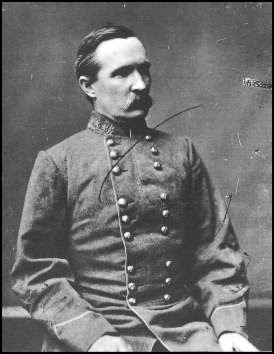
| Confederate General Henry Heth |
As the siege
of Petersburg began to take hold, Union Lieutenant General Ulysses S Grant
began to look for ways to break the railroad lines, and prevent supplies from
reaching Confederate General Robert E Lee’s Confederates. Grant wanted the Petersburg and Weldon
Railroad, which ran into Wilmington, North Carolina, stopped and had sent Major
General Winfield Scott Hancock’s II Corps in June and Major General Gouverneur
K Warren’s V Corps against the railroad in early August.
On August 22nd
1864 Grant again sent out the II Corps along with a cavalry division under
Brigadier General David M Gregg. Gregg’s
men drove off some Confederate pickets, and one of the II Corps division
commanders, Brigadier General Nelson A Miles’ men destroyed the track to within
2 miles of Reams Station. Early the next
morning August 23rd 1864 another II Corps commanded Brigadier General John
Gibbon took up position in some old earthworks located at Reams Station. Lee couldn’t afford to lose the railroad
supply line, and also Ream’s Station was the county seat and should they need
it, a potential retreat route. He sent
in Confederate Lieutenant General A P Hill’s Corps which was being led at the time by General Henry Heth, along with two divisions of
Major General Wade Hampton’s cavalry to drive them out.
On August 25th
1864 Union troops left their earthworks to destroy the last 5 miles of
tracks. Hancock had them recalled when
Confederate cavalry approached. Hill’s
column had advanced down the Dinwiddie Stage Road, and at about 2 pm three
infantry brigades led by Brigadier General Cadmus Wilcox launched an attack,
but were driven back. At about the same
time some of Hampton’s cavalry had swept around the Union line, but were
blocked by Gibbon’s division. More of
Hill’s Corps were brought up, and Confederate Colonel William Pregram’s
artillery began firing on the Union position.
The final attack began around 5:30 pm, with the Confederates breaking
through the northwest part of the Union fortifications. Two Union regiments panicked and ran and the
Confederates charged the earthworks.
Hancock galloped along the front of his men trying to rally his men; he said
“We can beat them yet. Don't leave me, for God's sake!" The Confederate cavalry at this point made a
dismounted charge against Gibbon’s troops causing them to panic, and giving
Hampton room to flank the Union line.
Hancock pulled together a counterattack that allowed the Union side to
make a withdrawal back to Petersburg.
Union
casualties were high, numbering about 2,750 along with 9 cannon and 12 stands
of colors, while the Confederates lost only about 800.


