Showing posts with label Battle of South Mountain. Show all posts

Friday, December 13, 2013

Advanced Even After His Loss

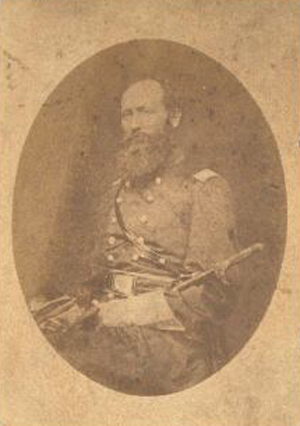
Union Brigadier General Conrad Feger Jackson was killed in action December 13th 1862 during the Battle of Fredericksburg.

Conrad Feger Jackson was born in Alsace Township, Berks County, Pennsylvania, September 11th 1813 the son of Isaac Jackson a part of a family of Quakers.  His father died when he was young and he was raised by an uncle; Joseph Jackson, in Chester County, Pennsylvania.  Jackson started working in warehouse in Philadelphia, Pennsylvania, and then moved onto working as a conductor for the Philadelphia and Reading Railroad.  During the Mexican American War, Jackson carried dispatches for General Winfield Scott.  He would settle after the war in Pittsburgh, Pennsylvania before moving in the late 1850’s to become the manager of an oil company in the Kanawha Valley area of Virginia.

When the Civil War started Jackson went back to Pittsburgh where he organized the 9th Pennsylvania Reserve Infantry.  He received an appointment from Pennsylvania Governor Andrew G Curtin as the Colonel of the 9th, leading them with distinction during the Peninsula Campaign.  He was promoted July 17th 1862 to Brigadier General and placed in command of the 3rd Brigade of the Pennsylvania Reserves.  They would see action at Second Bull Run, South Mountain and Antietam.

As the Union Army moved against the Confederates at Fredericksburg, Jackson led his Brigade against the right wing of the Confederates.  His Division commander Union General George G Meade wrote of their movement, “The Third brigade had not advanced over one hundred yards when the battery on the height on its left was re-manned, and poured a destructive fire into its ranks. Perceiving this, I dispatched my Aide-de-camp, Lieutenant Dehon, with orders for General Jackson to move by the right flank till he could clear the open ground in front of the battery, and then, ascending the height through the woods, sweep round to the left and take the battery. Unfortunately Lieutenant Dehon fell just as he reached General Jackson, and a short time after, the latter officer was killed. The regiments did, however, partially execute the movement by obliquing to the right, and advanced across the railroad, a portion ascending the heights in their front. The loss of their commander, and the severity of the fire, from both artillery and infantry, to which they were subjected, compelled them to withdraw."


Jackson was killed December 13th 1862.  His body was recovered from the field and taken back to Pittsburgh.  He is buried in the Allegheny Cemetery there.

Wednesday, July 31, 2013

Only Thirty Men Left

Col Peter A S McGlashan
On July 31st 1863 the 50th Georgia Infantry changed Colonels from Confederate Colonel William R Manning to Colonel Peter Alexander Selkirk McGlashan.

The 50th Georgia Infantry was organized at Savannah, Georgia March 4th 1862.  It was made up mostly of men from the southern part of the state.  They began drill at Camp Davis near Guyton, Georgia under the command of Confederate Colonel William R Manning.  On July 17th 1862 the 50th was sent to Richmond, Virginia to become a part of the First Corps of the Army of Northern Virginia under Robert E Lee.

The men of the 50th saw action in over 45 engagements, including the Battles of South Mountain, Sharpsburg; where they were part of the brigade which held the bridge over Antietam Creek, Chancellorsville and Gettysburg.  After the Battle of Gettysburg their Colonel William R Manning resigned his command due to health issues and was replaced on July 31st 1863 by Colonel Peter Alexander Selkirk McGlashan.  When Confederate General James Longstreet moved his Corps in the autumn of 1863 the 50th became engaged in the Siege of Knoxville.  They would return to the Army of Northern Virginia and continue on through war with fighting at Petersburg and the Battles of Cedar Creek and Sayler’s Creek, where their commander Colonel McGlashan was captured.  The men of 50th were still the Army of Northern Virginia when Robert E Lee surrendered at Appomattox Court House on April 9th 1865.  When the 50th surrendered it counted only 30 men on the line.

If you’re interested in reading more about this regiment, check out 50th Georgia Volunteer Infantry Confederate States of America (CSA)

Tuesday, February 26, 2013

He Turned In A Good Showing

Confederate Thomas Fentress Toon was elected Colonel of the 20th North Carolina February 26th 1863 following the Battle of Fredericksburg.

Thomas Fentress Toon was born in Columbus County, North Carolina June 10th 1840 the son of Anthony and Mary (McMillian) Toon.  He began his education at Wake Forest College, graduating after the start of the Civil War and his own enlistment.

Toon joined the 20th North Carolina Infantry, starting as their First Lieutenant and moving quickly to Captain.  After turning in a good showing at the battles of Seven Pines, South Mountain, and Fredericksburg, the men of the 20th elected Toon their Colonel.  He led his regiment at the Battle of Chancellorsville, Gettysburg and Mine Run.  During the Overland Campaign, Toon took over command of the brigade, when his Brigadier General Robert D Johnston was wounded at the Battle of Spotsylvania Courthouse.  He continued to lead the brigade during Lieutenant General Jubal Anderson Early’s raid on Washington, DC in July 1864.  Johnston returned to command in August and Toon went back to the 20th.  During the Confederate attack on Fort Stedman on March 25th 1865, he was wounded for the seventh time, ending his active duty.

Toon returned to North Carolina after the war ended.  He served as the superintendent of public instruction.  Toon died February 19th 1902 in Raleigh, North Carolina.  He is buried in the Oakwood Cemetery in Raleigh, North Carolina.

Tuesday, July 10, 2012

Another Death From Gettysburg

Confederate General Paul Jones Semmes died from wounds he received at the Battle of Gettysburg on July 10th 1863.

Paul Jones Semmes was born June 4th 1815 at Montford’s Plantation in Wilkes County, Georgia.  He attended the University of Virginia, becoming a banker and the owner of a plantation in Columbus, Georgia.  Semmes was a Captain in the Columbus Guards and in 1855 he wrote a guide to Infantry Tactics.  Georgia Governor Joseph E Brown made Semmes the Quartermaster General of the state in 1860, allowing him to make all the states military purchases.

After the Civil War started Semmes became a Colonel in the 2nd Georgia Infantry.  He was promoted on March 11th 1862 to Brigadier General.  He saw action in the Peninsula Campaign and at Crampton’s Gap during the Battle of South Mountain.  At the Battle of Antietam Semmes’ Brigade was a part of Confederate General Lafayette McLaws’ counterattack on the Union Second Corps.  His brigade was also active at Chancellorsville.

During the Battle of Gettysburg Semmes led his men in a charge into the Wheatfield, where on July 2nd 1863 he was wounded in the thigh.  He was taken by ambulance to Martinsburg, West Virginia where he died July 10th 1863.  Semmes is buried in the Linwood Cemetery in Columbus, Georgia.

Sunday, January 17, 2010

From Harvard, To War, To President

The nineteenth United States president Rutherford B Hayes died January 17th 1893.

Rutherford B Hayes was the son of Rutherford and Sophia [Birchard] Hayes and was born October 4th 1822 in Delaware Ohio. His father passed away two months before his birth, and so he was raised by an uncle. Hayes attended schools in Ohio and Connecticut and graduated valedictorian of his class from Kenyon College. He went on to get a law degree in 1845 from Harvard Law School. He became a successful lawyer practicing in Cincinnati, Ohio. Hayes' opposition to slavery brought him into the Republican Party.

He volunteered his services at the start of the Civil War to the state of Ohio, and was appointed to the rank of Major in the 23rd Ohio Volunteer Infantry. He was wounded in the Battle of South Mountain on September 14th 1862. In 1864 Hayes was elected to Congress, but was still serving in the army and didn't take his seat until after the Union won the war.

In 1867 Hayes was elected Governor of Ohio. In 1876 he was elected President of United States. He brought about many progressive changes in the government including allowing women attorneys to argue before the Supreme Court. Hayes honored a commitment not to take a second term, and retired to his home in Fremont, Ohio. From here he worked for Civil War veterans, helping them get their pensions. He died at his home in Ohio at the age of seventy on January 17th 1893.

Monday, September 14, 2009

Death's Of Two General

Fox’s Gap, one part of three battles known collectively as the Battle of South Mountain were fought on September 14th 1862.

The Battle of Fox Gap was one of the three battle fought on September 14th 1862, known as the Battle of South Mountain. Major General George B McClellan’s Army of the Potomac needed the passes in order to pursue General Robert E Lee’s Confederate Army of the Northern Virginia. Confederate General A P Hill’s division defended Fox Gap against Brigadier General Jacob D Cox. Cox’s Kanawha Division attack at 9am and secured south side of the gap. The Union troops pushed through the North Carolina troops at the crest of the gap, but were exhausted when they got there, and the failed to drive the Confederates out. Major General Jesse Reno sent in more Union troops, but they were unable to dislodge the Confederates due to Brigadier General John Bell Hood’s reinforcements.

At the end of the day, with Crampton’s Gap lost to the Confederates and Fox’s and Turner’s Gap sketchy at best, Lee ordered a withdrawal from the area. Confederate Brigadier General Samuel Garland Jr and Union Major General Jesse Reno were both killed in nearly the same spot at Fox’s Gap, with in hours of eachother. With Confederates broke up, McClellan could have closed in but instead gave Lee time pull his divisions together in time for the coming battle of Antietam.

Another good web site
The Battle of South Mountain Fox's Gap