Monday, November 29, 2010

A Massacre In The West

While the war went on the east, on November 29th 1864 in Colorado the Sand Creek Massacre took place.

Part of the Indian Wars, the Sand Creek Massacre was an attack on friendly Cheyenne and Arapahos by a 700 man force of the 1st Colorado Volunteers under the command of Union Colonel John Chivington. On November 29th 1864 the 1st Colorado destroyed a village, of mostly women and children, killing and mutilating about 160 Indians. The Cheyenne living under Chiefs Black Kettle and White Antelope were considered “Friendly Indians” and had been told to camp near Fort Lyon. They set up their camp about 40 miles north along Sand Creek. Once settled Black Kettle sent all but about 60 old men off to hunt for the camp. He flew the American flag; given to him by a Untied State officer, over his lodge to show he was friendly and prevent an attack.

Leaving from Fort Lyon on November 28th 1864, Colonel Chivington with the 1st and 3rd Colorado Cavalry, and the 1st New Mexico Volunteers, marched on Black Kettle’s camp. Chivington ordered the troops to attack on the early morning on November 29th 1864. The officers of companies “D” and “K” of the 1st Colorado, under Captain Silas Soule and Lieutenant Joseph Cramer refused the order and had their men hold their fire. The dead among the Indians were shot and trampled, many killed by cannon fire as they tried to escape up the creek. The bodies were grossly mutilated, from the youngest child to oldest person. After the killings Chivington and his men took horses, plundered and burned the tipies.

There were causalities among the Union solders, but they were low, with 24 killed and 52 wounded. There were roughly 133 Indians killed of who 105 were women of children.

Sunday, November 28, 2010

A Running Battle In Arkansas

The Battle of Cane Hill was fought in Washington County Arkansas on November 28th 1862.

As part of the Confederate strategy to push the Union troops back into Missouri, the Battle of Cane Hill was fought to gain back ground lost during the Pea Ridge campaign. Confederate Major General Thomas C Hindman with about 11,000 soldiers moved into Fort Smith, Arkansas and got ready to move across the Boston Mountains located in the northwestern part of the state. About 5,000 Union troops under the command of Brigadier General James Blunt, were waiting for them. Trying to hold the Union force in place, Hindman sent 2,000 cavalry under the command of Brigadier General John S Marmaduke to keep Blunt’s men busy while the rest of the Confederates moved through mountains.

Union troops learned of the Marmaduke’s cavalry and moved south about 35 miles, surprising the Confederate cavalry by suddenly attacking them on November 28th 1862. Marmaduke ordered a retreat with Colonel Joseph Shelby’s cavalry covering as the rest of the Confederates headed for the mountains. Blunt’s force pursued the retreating Confederates for 12 miles, with a running fight going on all the way. The battle lasted for about nine hours, with the Union loosing about 41 men and the Confederates about 435.

Friday, November 26, 2010

A National Day Of Thanksgiving

November 26th 1863 was the first national Thanksgiving Day as proclaimed by President Abraham Lincoln.

There were other days of Thanksgiving proclaimed in the United States’ history with President James Madison calling for the last. President Abraham Lincoln proclaimed a notional day of Thanksgiving during the Civil War to be celebrated on the last day of November. He was pushed towards this holiday of Thanksgiving by the writings of Sarah Josepha Hale. The first one was held on November 26th 1863.

The proclamation read, “The year that is drawing towards its close, has been filled with the blessings of fruitful fields and healthful skies. To these bounties, which are so constantly enjoyed that we are prone to forget the source from which they come, others have been added, which are of so extraordinary a nature, that they cannot fail to penetrate and soften even the heart which is habitually insensible to the ever watchful providence of Almighty God. In the midst of a civil war of unequalled magnitude and severity, which has sometimes seemed to foreign States to invite and to provoke their aggression, peace has been preserved with all nations, order has been maintained, the laws have been respected and obeyed, and harmony has prevailed everywhere except in the theatre of military conflict; while that theatre has been greatly contracted by the advancing armies and navies of the Union. Needful diversions of wealth and of strength from the fields of peaceful industry to the national defense, have not arrested the plough, the shuttle, or the ship; the axe had enlarged the borders of our settlements, and the mines, as well of iron and coal as of the precious metals, have yielded even more abundantly than heretofore. Population has steadily increased, notwithstanding the waste that has been made in the camp, the siege and the battle-field; and the country, rejoicing in the consciousness of augmented strength and vigor, is permitted to expect continuance of years, with large increase of freedom. No human counsel hath devised nor hath any mortal hand worked out these great things. They are the gracious gifts of the Most High God, who, while dealing with us in anger for our sins, hath nevertheless remembered mercy. It has seemed to me fit and proper that they should be solemnly, reverently and gratefully acknowledged as with one heart and voice by the whole American people. I do therefore invite my fellow citizens in every part of the United States, and also those who are at sea and those who are sojourning in foreign lands, to set apart and observe the last Thursday of November next, as a day of Thanksgiving and Praise to our beneficent Father who dwelleth in the Heavens. And I recommend to them that while offering up the ascriptions justly due to Him for such singular deliverances and blessings, they do also, with humble penitence for our national perverseness and disobedience, commend to his tender care all those who have become widows, orphans, mourners or sufferers in the lamentable civil strife in which we are unavoidably engaged, and fervently implore the interposition of the Almighty Hand to heal the wounds of the nation and to restore it as soon as may be consistent with the Divine purposes to the full enjoyment of peace, harmony, tranquility and Union. In testimony whereof, I have hereunto set my hand, and caused the seal of the United States to be affixed. Done at the city of Washington, this third day of October, in the year of our Lord one thousand eight hundred and sixty-three, and of the independence of the United States the eighty-eighth."

Thursday, November 25, 2010

A Union From Tennessee

Union Army General Joseph Alexander Cooper, farmer, civil servant, and soldier was born November 25th 1823.

Joseph Alexander Cooper was born near Cumberland Falls, Kentucky November 25th 1823. When he was a year old he and his parents moved to Campbell County, Tennessee, where he grew up. Cooper married Mary J Hutson in April 1846. During the Mexican-American War he enlisted as a private in the 4th Tennessee Infantry. When the war was over Cooper returned to his home in Jacksboro, Tennessee where he went back to farming.

At the beginning of the Civil War Cooper was elected a delegate to the 1861 Union Convention at Knoxville, Tennessee. He recruited men around his home county, they were sworn into service as part of the 1st Tennessee Infantry in Whitesburg, Kentucky. After battles at Wild Cat Mountain and Mill Springs, Cooper was promoted to Colonel, and given command of the 6th Tennessee May 1862. He and the 6th Tennessee saw action at Stone River, in the Chattanooga Campaign, and at Chickamauga. As part of the army of Union Major General William Tecumseh Sherman, Cooper was promoted to Brigadier General during the Atlanta Campaign on July 30th 1864. Cooper would be in command of the 2nd Division of the 23rd Corps during the Franklin and Nashville Campaign, for which he would be brevetted Major General. He was mustered out of service January 15th 1866.

Returning to Tennessee Cooper ran unsuccessfully in 1868 for United States Senate. He received an appointment from President Ulysses S Grant to be the IRS collector in the Knoxville district from 1869 to 1879. The Governor of Tennessee asked him help with the putting down the Ku Klux Klan in the state. He moved to Stafford County, Kansas in 1880 and went back to farming. Cooper died there May 20th 1910, and is buried in the Knoxville National Cemetery.

Wednesday, November 24, 2010

Above The Clouds

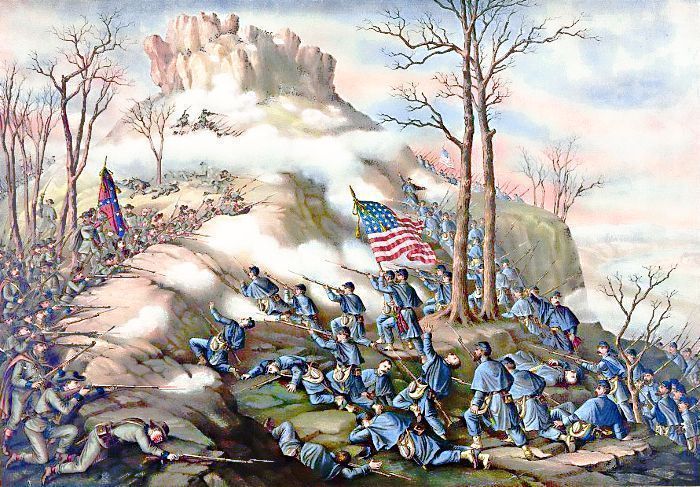
The Battle of Lookout Mountain, near Chattanooga, Tennessee was fought November 24th 1863.


Lookout Mountain is known for unique weather, in which fog covers the valley about half way down the mountain. This weather caused the battle fought November 24th 1863 on Lookout Mountain, to also be known as the Battle Above the Clouds. With 12,000 men located west of Chattanooga, Union General Joseph “Fighting Joe” Hooker crossed Lookout Mountain Creek advancing through a thick mist, they found about 1,200 Confederates entrenched on the side of Lookout Mountain. The Confederates under the command of Major General Carter L Stevenson, began a fighting withdrawal toward the northern face of Lookout Mountain. Hooker ordered artillery to fire on the Confederate line of retreat, but the effect was minimal do the poor visibility. Heavy fighting took place at Cravens House on the sheer north slope of the mountain.

Confederate General Braxton Bragg ordered an withdrawal of the men on the Mountain. They were to join up with him on Missionary Ridge for a battle that would take place the next day. The Union held Lookout Mountain with the loss of 629 men, 81 of which were deaths.

Tuesday, November 23, 2010

A Vermonter In The Deep South

Charles Henry Sheldon a Union Captain and future Governor of South Dakota joined Company E of the 7th Vermont Infantry November 23rd 1861.

Charles Henry Sheldon was the son of Gresham and Mary [Brown] Sheldon, and was born September 12th 1840 in Johnson, Lamoille County, Vermont. His father died when he was young and he went to work at 12 as labor on a farm, and a store clerk to help support his family. Sheldon was active in the local abolitionist movement.

With the coming of the Civil War Sheldon volunteered and joined the 7th Vermont Infantry on November 23rd 1861. The 7th Vermont took parts in Battles for Baton Rouge, Mobile, and many other action in the deep south. He was mustered out of service at Brownsville, Texas as a Captain July 13th 1866.

Following the war he lived in Pope County Illinois and worked in a store. He took a government land grant and settled in Groton, Brown County, Dakota, taking up farming. He entered politics in 1886 representing Day, Roberts, Grant and Codington Counties in the Territorial Legislature. In 1892 Sheldon was nominated by the Republican convention for Governor, becoming the second governor of the state of South Dakota. He served two terms. He retired from politics in 1897 and went back to farming. Sheldon went on a speaking tour in support of the Republican party during the 1898 election. After giving a speech at Deadwood, Lawrence County, South Dakota on October 15th 1898, he developed pneumonia and died five day latter. He is buried in the Pierpont Cemetery, in Pierpont South Dakota.

Monday, November 22, 2010

Control Through Laws

Mississippi passed the first Black Codes November 22nd 1865.

The Thirteenth Amendment was ratified in 1865 formally abolishing slavery through out the Untied States and her territories. Southern states began to look for a way to restore the control and economic power over African Americans that, that amendment had denied them. For some Southern’s vigilantism was the way they regained that control, for others it was through laws. Mississippi passed the first of these laws, known as Black Codes on November 22nd 1865. It directed that minor orphaned “freedmen, free negroes and mulattoes” be hired by civil officers, and then they were forbidden to leave their place of employment, and could be subjected to “moderate corporal chastisement”. There was a law requiring African Americans to carry evidence in writing of their employment. Mississippi’s legislature established special county courts to punish those who broke these laws. Other Southern state followed Mississippi’s lead, and created similar laws.

The United State Congress responded to these Black Codes by passing the Civil Rights Act of 1866. The States ratified the Fourteenth Amendment two years latter guarantee “equal protection of the laws” to all people.