Showing posts with label Chattanooga. Show all posts

Wednesday, May 2, 2012

I Shut My Eyes

Union General John Basil Turchin looked the other way on May 2nd 1862, when his troops had their way with Athens, Alabama.

John Basil Turchin was born with the name Ivan Vasilyevich Turchaninov on December 24th 1821 in Russia.  He attended the Imperial Military School in St Petersburg, Russia.  Turchin served with the Russian Guards and saw action as a Colonel in the Crimean War.  He and his wife immigrated to the United States in 1856.  He settled in Chicago, Illinois and went to work for the Illinois Central Railroad.

When the Civil War started Turchin joined the 19th Illinois Infantry, and became their Colonel.  His unit was place under the command of Union Major General Don Carlos Buell in the Army of the Ohio.  Turchin’s was soon commanding a brigade that was part of the Third Division under Brigadier General Ormsby McNight Mitchel.  Buell moved to support Union General Ulysses S Grant at Shiloh, and sent Mitchel south to Huntsville, Alabama to cut the rail line there.  This move over extended the Union line, and Turchin’s men were badly handled, with the locals firing on them from their windows while trying to hold the town of Athens, Alabama.  Turchin’s men finally occupied the town of Athens on May 2nd 1862.  He brought his men together and told them, "I shut my eyes for two hours. I see nothing."  What followed has been called the “Rape of Athens”, with Turchin leaving his men to loot the town.

When Buell heard about the incidence he court-martialed Turchin.  The proceedings became the focus of the nation.  The debate surrounded on the how the conciliatory policy to Southerns were causing Union casualties to grow.  Before the court-martial was finished Turchin received a promotion to Brigadier General.  Turchin continued to serve, distinguishing himself at Chickamauga and Chattanooga.

Turchin suffered heatstroke and resigned his command October 1864.  He returned to Chicago, where he worked as a civil engineer, and invested in real estate.  He developed dementia which was attributed to the heatstroke he suffered while in the army.  Turchin died June 18th 1901 in Anna, Illinois.

Friday, January 7, 2011

He Ran Stores And Led Men

Union Brigadier General Samuel Emerson Opdycke was born January 7th 1830.


Samuel Emerson Opdycke was born on a farm in Hubbard, Ohio January 7th 1830. He came from a family with a long military history. Opdycke attended local schools, and then operated various businesses in Ohio. He went to California during the Gold Rush and opened a mercantile store.

Shortly after the First Battle of Bull Run, Opdycke enlisted in the Union army as a First Lieutenant in the 41st Ohio Infantry. He saw action with the 41st at the Battle of Shiloh. Opdycke resigned and went back to Ohio in September 1862 to recruit the 125th Ohio Infantry. He was there as a Colonel when the 125th saw action at Horseshoe Ridge during the Battle of Chickamauga. Opdycke and the 125th were also present at Missionary Ridge, the Battle of Chattanooga and Battle of Resaca where he was badly wounded in the arm. Opdycke had recovered enough to be at the head of his men during the Battle of Kennesaw Mountain, and at the Battle of Franklin. He received a promotion to Brigadier General July 26th 1865. Opdycke resigned from the army in 1866.

Following the war Opdycke moved to New York City. He opened a dry good store, was active with veterans affairs, and wrote about the war. While he was cleaning a pistol, Opdycke accidentally shot himself in the stomach. He died April 25th 1884 and is buried in the Oakwood Cemetery in Warren, Ohio.

Saturday, December 18, 2010

He Served Through Out The War

Union Brigadier General Green Berry Raum a politician, author and lawyer died December 18th 1909.

Green Berry Raum was born December 3rd 1829 in Golconda, Illinois. He attended local schools, studied law and admitted to the bar in Illinois in 1853.

Raum enlisted in the Union Army when the Civil War started. He was a Major in the 56th Illinois Infantry, and was their Colonel by 1862. Serving under Major General William S Rosecrans during the Siege of Corinth, Raum ordered the charge on the Confederate left, capturing an artillery battery. They were part of the army at the surrender of Vicksburg, Mississippi in July 1863, and he led the 2nd Brigade of the 2nd Division of the XVII Corps at Chattanooga. Raum was wounded at the Battle of Missionary Ridge November 1863. In 1864 Raum’s brigade held the line of communication during the Atlanta Campaign. He received a brevet to Brigadier General in September 1864. He and his men were called in to reinforce Resaca, Georgia in October and held the town against Confederate General John Bell Hood. He served through to the end of the war.

Following the war Raum returned to his home in Illinois. In 1866 he secured the charter for the Cairo and Vincennes Railroad and became its first president. He ran for and served as a Congressmen for two terms. Raum was the United States Commissioner for the Internal Revenue Service from 1876 through 1883. He oversaw the Commission of Pension, rejecting or accepting Union Civil War pension application from 1889 to 1893. Raum spent the rest of his life practicing law in Chicago, Illinois. He died December 18th 1909, and is buried in Arlington National Cemetery in Arlington, Virginia.

Thursday, November 25, 2010

A Union From Tennessee

Union Army General Joseph Alexander Cooper, farmer, civil servant, and soldier was born November 25th 1823.

Joseph Alexander Cooper was born near Cumberland Falls, Kentucky November 25th 1823. When he was a year old he and his parents moved to Campbell County, Tennessee, where he grew up. Cooper married Mary J Hutson in April 1846. During the Mexican-American War he enlisted as a private in the 4th Tennessee Infantry. When the war was over Cooper returned to his home in Jacksboro, Tennessee where he went back to farming.

At the beginning of the Civil War Cooper was elected a delegate to the 1861 Union Convention at Knoxville, Tennessee. He recruited men around his home county, they were sworn into service as part of the 1st Tennessee Infantry in Whitesburg, Kentucky. After battles at Wild Cat Mountain and Mill Springs, Cooper was promoted to Colonel, and given command of the 6th Tennessee May 1862. He and the 6th Tennessee saw action at Stone River, in the Chattanooga Campaign, and at Chickamauga. As part of the army of Union Major General William Tecumseh Sherman, Cooper was promoted to Brigadier General during the Atlanta Campaign on July 30th 1864. Cooper would be in command of the 2nd Division of the 23rd Corps during the Franklin and Nashville Campaign, for which he would be brevetted Major General. He was mustered out of service January 15th 1866.

Returning to Tennessee Cooper ran unsuccessfully in 1868 for United States Senate. He received an appointment from President Ulysses S Grant to be the IRS collector in the Knoxville district from 1869 to 1879. The Governor of Tennessee asked him help with the putting down the Ku Klux Klan in the state. He moved to Stafford County, Kansas in 1880 and went back to farming. Cooper died there May 20th 1910, and is buried in the Knoxville National Cemetery.

Wednesday, November 24, 2010

Above The Clouds

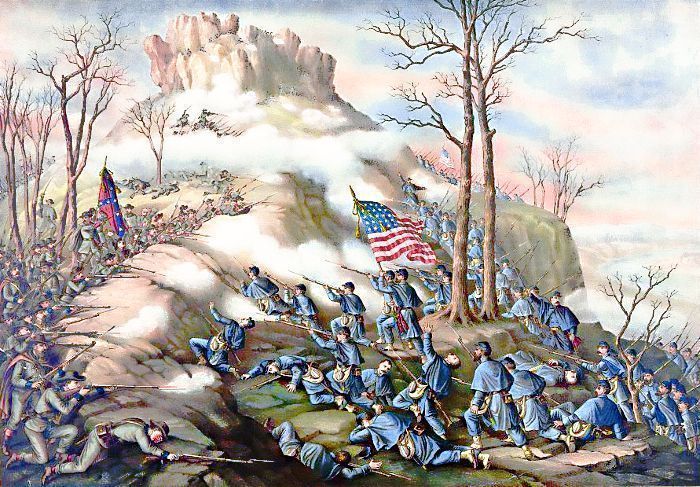
The Battle of Lookout Mountain, near Chattanooga, Tennessee was fought November 24th 1863.


Lookout Mountain is known for unique weather, in which fog covers the valley about half way down the mountain. This weather caused the battle fought November 24th 1863 on Lookout Mountain, to also be known as the Battle Above the Clouds. With 12,000 men located west of Chattanooga, Union General Joseph “Fighting Joe” Hooker crossed Lookout Mountain Creek advancing through a thick mist, they found about 1,200 Confederates entrenched on the side of Lookout Mountain. The Confederates under the command of Major General Carter L Stevenson, began a fighting withdrawal toward the northern face of Lookout Mountain. Hooker ordered artillery to fire on the Confederate line of retreat, but the effect was minimal do the poor visibility. Heavy fighting took place at Cravens House on the sheer north slope of the mountain.

Confederate General Braxton Bragg ordered an withdrawal of the men on the Mountain. They were to join up with him on Missionary Ridge for a battle that would take place the next day. The Union held Lookout Mountain with the loss of 629 men, 81 of which were deaths.