Friday, August 31, 2012

The First In New Jersey

Union General George William Taylor died August 31st 1862 from wounds received a few days earlier at the Second Battle of Manassas.

George William Taylor was born November 22nd 1808 at his family home “Solitude” in High Bridge, New Jersey, the son of Archibald Stewart and Nancy Ann (Bray) Taylor.  He graduated from Partridge's American Literary, Scientific and Military Academy in Middletown, Connecticut.  After graduation Taylor went to work at his father’s company Taylor Iron & Steel Company.  In 1827 He joined the United States Navy, serving until 1831, when he went back into family business.  When the Mexican American War started Taylor served under General Zachary Taylor in the 10th US Infantry.  Following his service in the Mexican American War, he spent a time looking for gold in California, before returning to New Jersey and the iron company.

When the Civil War started Taylor help recruit what would become the 3rd New Jersey Infantry.  He would be their Colonel.  The 3rd would become a part the famed “First New Jersey Brigade” and Taylor and the 3rd would see action at First Bull Run and many battles during the Peninsula Campaign.  Taylor was promoted May 9th 1862 to Brigadier General and given command of the 1st New Jersey Brigade.  On August 27th 1862 while Taylor’s Brigade was deployed at Manassas Junction near Bull Run Bridge, he was wounded in leg by an artillery shell.

Taylor died August 31st 1862 in the Washington, DC area.  His body was sent by train to Clinton, New Jersey.  He is buried in the Riverside Cemetery in Clinton, New Jersey.

Thursday, August 30, 2012

There Will Be No More Peace

A part of what is known as “Bleeding Kansas” the Battle of Osawatomie was fought August 30th 1856 between pro-slavery men and Free State men, and included John Brown.

About 275 pro-slavery men, led by John W Reid and Reverend Marvin White attacked Osawatomie August 30th 1856.  The plan was to destroy the town and then move on to the other Free State towns of Topeka and Lawrence, Kansas.  These pro-slavery men shot Frederick Brown, the son of John Brown, there by alerting the Free State men living in Osawatomie.  Brown with forty men did what they could to defend the town, but after a number of casualties the men from Osawatomie had to withdraw.  Once Osawatomie had been vacated Reid and White’s group looted and burnt the town.

As Brown watched the town of Osawatomie burn he was said to have said, “God sees it, I have only a short time to live - only one death to die, and I will die fighting for this cause. There will be no more peace in this land until slavery is done for."

For more information you might want to look at Kansas Legends Battle of Osawatomie

Wednesday, August 29, 2012

Opening Up Kentucky

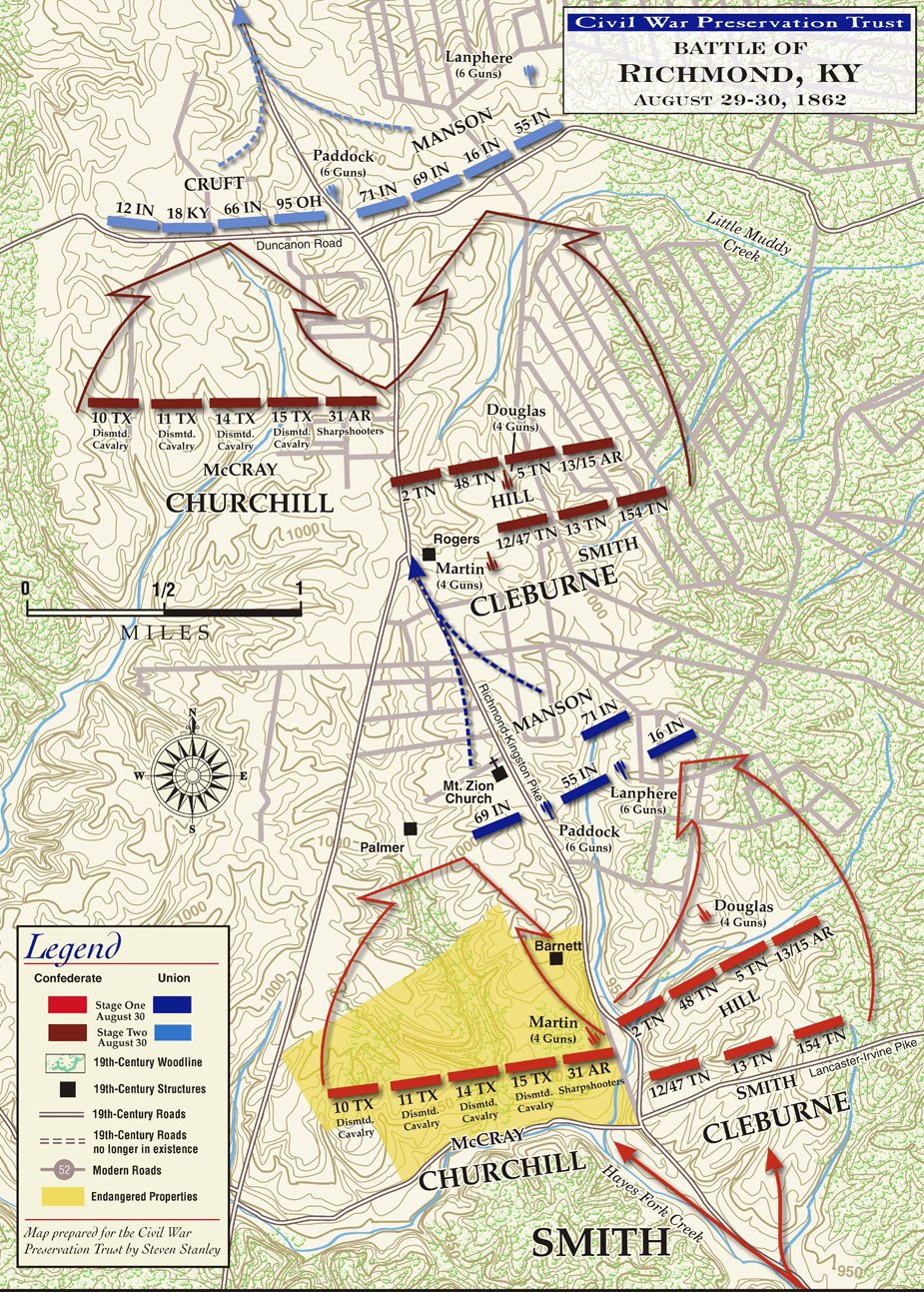
A Confederate victory the Battle of Richmond was fought August 29th and 30th 1862 in the Richmond, Kentucky area.

In August 1862 two Confederate armies moved into Kentucky looking to threaten Union areas along the Ohio River and do some recruiting.  These were commanded by Brigadier General Edmund Kirby Smith and Major General Braxton Bragg.  They moved more or less parallel across the state, with Smith moving from Knoxville and Bragg from Chattanooga.

Smith’s men moved north on August 29th 1862 from Big Hill, Kentucky toward Richmond, Kentucky, where they met Union skirmishers.  Shortly after noon Union artillery and infantry came up, forcing Smith’s cavalry under Confederate Colonel John S Scott to retreat back to Big Hill.  Union troops in the area were commanded by Brigadier General Mahlon Dickerson Manson, and they pursued and skirmished with the Confederates into the late afternoon.  That night Manson reported to his commander Major General William Bull Nelson.

The fighting continued the next day with each bringing in more troops.  In the end the Union troops retreated.  The Confederates captured about 4,300 Union men.  The Union also had 78 men killed and 372 wounded and 1 missing.  This battle laid open the way for the Confederate to move north towards Lexington and Frankfort.

Tuesday, August 28, 2012

Holdong The Gap

Part of the Northern Virginia Campaign and a part of the set up to the Second Battle of Manassas, the Battle of Thoroughfare Gap was fought August 28th 1862.  It is also known as the Battle of Chapman’s Mill.

Confederate Major General Thomas J Stonewall Jackson took his troops through Thoroughfare Gap on August 26th 1862, on his way to raid the Union supply depot at Manassas Junction.  The next day Union Major General Irwin McDowell headed for Manassas in pursuit.  To protect his left flank he sent the 1st New Jersey Cavalry and Brigadier General James B Ricketts’ Brigade towards Thoroughfare Gap.  Ricketts’ halted about 6 miles east of the Gap at Gainesville, Virginia, sending the Cavalry to occupy the Gap.  At the same time Confederate Major General James Longstreet’s Corps was following Jackson, coming toward the Gap from the West.

On the morning of August 28th 1862 the 1st New Jersey Cavalry encountered Longstreet’s lead troops while they were falling trees to block the road on the East side of the Gap.  Word was sent to Ricketts to bring up his troops, but he moved slowly, only making it as far as Haymarket still 3 miles from the Gap at 2 pm.  At that point Longstreet had pushed the Union Cavalry out of the Gap.

Longstreet moved his men to the high ground on either side of the Gap and then moved to outflank the Union position.  The 9th Georgia Infantry part of Confederate Colonel George T Anderson brigade moved to Chapman’s Mill on the East side of the Gap and attacked the 11th Pennsylvania. South of the Gap the 2nd and 20th Georgia met the 13th Massachusetts and drove them back down the steep slopes.  Holding the Gap, Confederate Colonel Evander M Law’s Brigade moved against the Union right at the same time Confederate Brigadier General Cadmus M Wilcox took 3 Brigades North through Hopewell Gap to outflank the Union and hit them in the rear.  With the Union position becoming untenable Ricketts ordered the men to fall back to Gainesville, leaving the Gap before Wilcox got into position to cut him off.

This was a rather small action, but opened up the way for Longstreet to join his Corps with Jackson’s leading to the Union loss at the Second Battle of Manassas.

Monday, August 27, 2012

Brother After Brother

The skirmish known as the Fight at Waterford took place August 27th 1862 in the Waterford, Virginia area.

Union Captain Samuel C Means commanding the Loudoun Rangers; an independent force, moved on August 26th 1862 into Waterford, Loudoun, Virginia to prepare a movement against Confederates in the area.  He stationed pickets on the six roads leading into town, placed Lieutenant Luther Slater in command before retiring.  Confederate Captain Elijah V White leading about 100 cavalry under supervision of Confederate General Richard S Ewell moved into the Loudoun County, Virginia area.  They learned of Means’ presence in the area.

With the help of locals in the early morning hours of August 27th 1862 White’s men approached Waterford.  White split his force sending 30 men on horses down the road to draw the Union troops out, while another 20 on foot waited nearby to fire on Means’ soldiers if they took the bait.  White’s men opened fire early sending the Rangers into the Baptist Church, losing 1 killed and 2 wounded including Slater.  The Confederates laid a fire into the church, while some of the men went looking for Means, who had already escaped with some of the pickets.

After several hours of fighting and almost out of ammunition the Rangers in the church finally agreed to surrender as long as all the men would be paroled.  White who was also running short of ammo took the Union horses and paroled 19 of Means men found in the church.  It was during the surrender that William Snoot a member of White’s cavalry ran into church planning to kill his brother Charles Snoot who was fighting with the Loudoun Rangers.  He was disarmed before reaching his brother.

If you are interested in reading more, please look at The Fight at the Baptist Church, Waterford, 1862

Friday, August 24, 2012

Fight Manfully For Our Just And Holy Cause

Eli Lilly was elected Captain August 24th 1862 of Lilly’s Hoosier Battery, or the 18th Independent Battery Indiana Light Artillery.

The 18th Independent Battery Indiana Light Artillery was formed by Eli Lilly an Indianapolis, Indiana pharmacist.  He recruited for the Battery from around the city and among his friends and classmates.  He posted recruiting posters around the city that said “fight manfully for our just and holy cause.”  The 18th had six ten pounder Parrott’s that were manned by 150 men.  The unit mustered in in Indianapolis and Lilly was elected Captain August 24th 1862.  The 18th was commanded by Union Colonel John T Wilder.  They enlisted for three years becoming a part of the Army of the Cumberland and saw action at the Battles of Hoover’s Gap, Second Chattanooga, Chickamauga and others.  The 18th had 12 men killed in battle and another 31 die from disease.

If you’re interested in more information The 18th Indiana Light Artillery  is a good place to look.

Thursday, August 23, 2012

Closing The Bay

A part of the Battle for Mobile Bay, Fort Morgan fell on August 23rd 1864 to Union forces.

The Confederate navy in Mobile Bay was defeated by Union Admiral David Glasgow Farragut on August 5th 1864.  Fort Gaines which protected the western side of the Bay surrendered to a land force under the commanded of Union Major General Gordon Granger.  The Union command then turn their attention to Confederate held Fort Morgan.  The Fort was under Confederate Brigadier General Richard Lucian Page, who had about 600 men in his command.

Granger’s soldiers began moving siege artillery into range of the Fort on August 9th 1864.  Farragut had his ships guns turned toward the Fort.  For the next two weeks the Union guns fired on the Fort, keeping up consistent bombardment.

Page was forced on August 23rd 1864 to unconditionally surrender the Fort.  Refusing the turn over his sword to the Union, Page broke it over his knee.  He had his cannon spiked before surrendering and turning the Fort over.  The fall of this Fort shut down Mobile Bay as a port for the Confederates.